Exchange Rate Board Software for US Currency Exchange Stores
We Buy and We Sell rates in dollars on your window and counter screens, worked out from the official daily reference rates with your own margins, or locked at the rates you type. English and Spanish on the same board, gold and silver by the gram, and no monthly fee per screen.
A currency exchange store sells one thing customers compare before they walk in: the rate. In a mall, an airport or a border town, the board in the window does the selling, and the board at the counter settles the argument. Plenty of stores still run it on an LED number board, a laminated sheet or a TV showing a spreadsheet that someone retypes every morning.
easyCMS has a currency board built for exchange stores. This page covers what it shows in a US store, where the rates come from, what the rules ask, what it costs in dollars, and what it will not do.
What the board shows
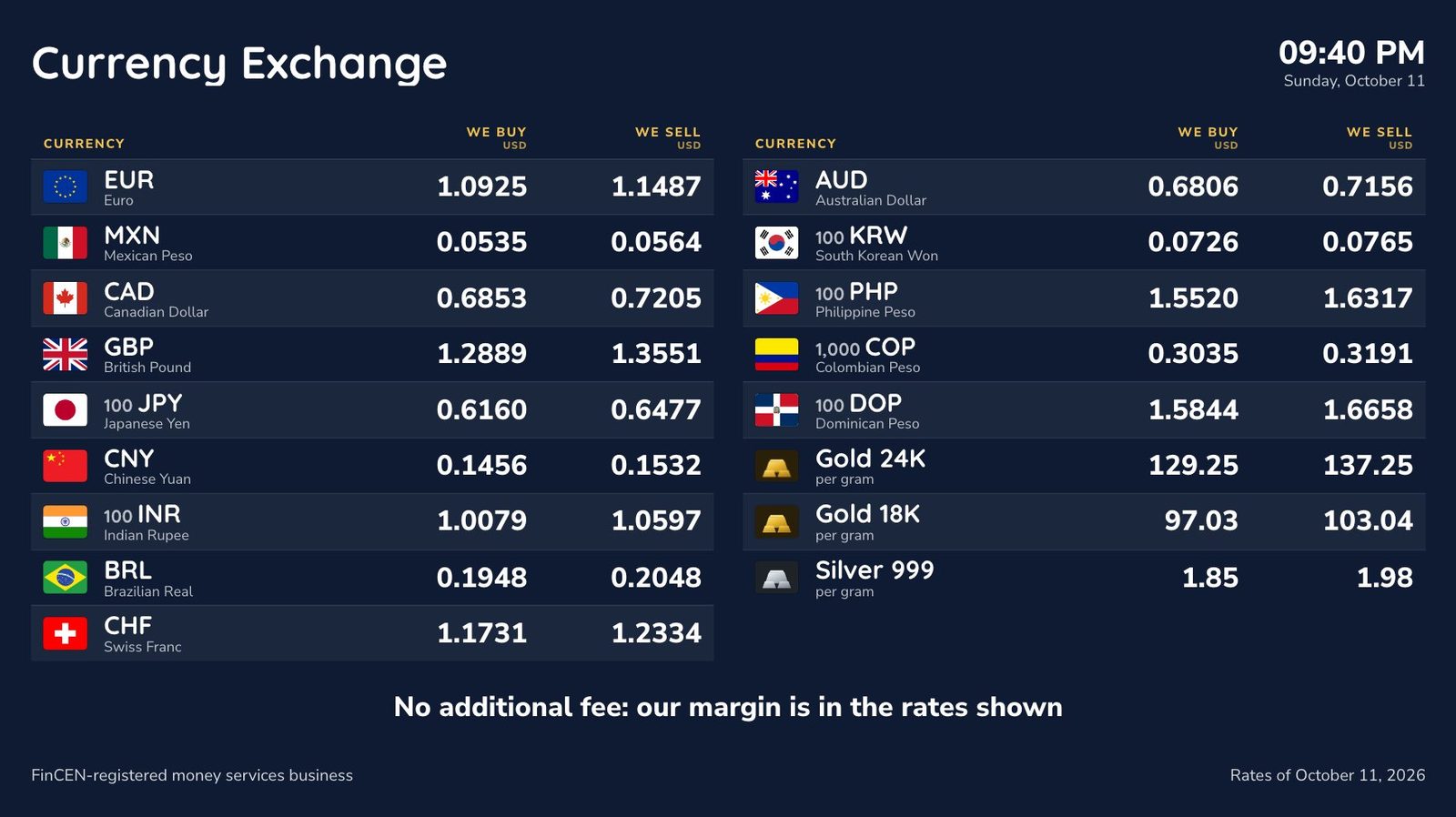
- We Buy and We Sell for each currency, in dollars, buy column first, with flags and names: the euro, the Mexican peso, the Canadian dollar, the pound, the yen and up to 60 currencies in all.
- The unit next to the code, so the yen, the won and the Colombian peso read per 100 or per 1,000 instead of a row of zeros.
- Gold and silver by the gram: 24, 22, 18 and 14 karat gold and silver 999, with their own margins.
- A fee line printed as large as the rates, so a fee or a “no additional fee” statement is as readable as the numbers, and a footer line for your registration or license details.
- Your logo, the time and the date, and the date of the rates.
Rates read as the price of each foreign currency in dollars (1 EUR = 1.09 USD), or, if your customers think the other way round, as foreign units per dollar for the whole board (1 USD = 18.20 MXN).
There are five designs: a portrait window board, a two-column counter board, reception rates with a few currencies in large type, a spotlight that shows one currency at a time filling the screen, and a scrolling ticker for an LED strip. All of them are on the exchange rate board templates page.
English and Spanish on one board
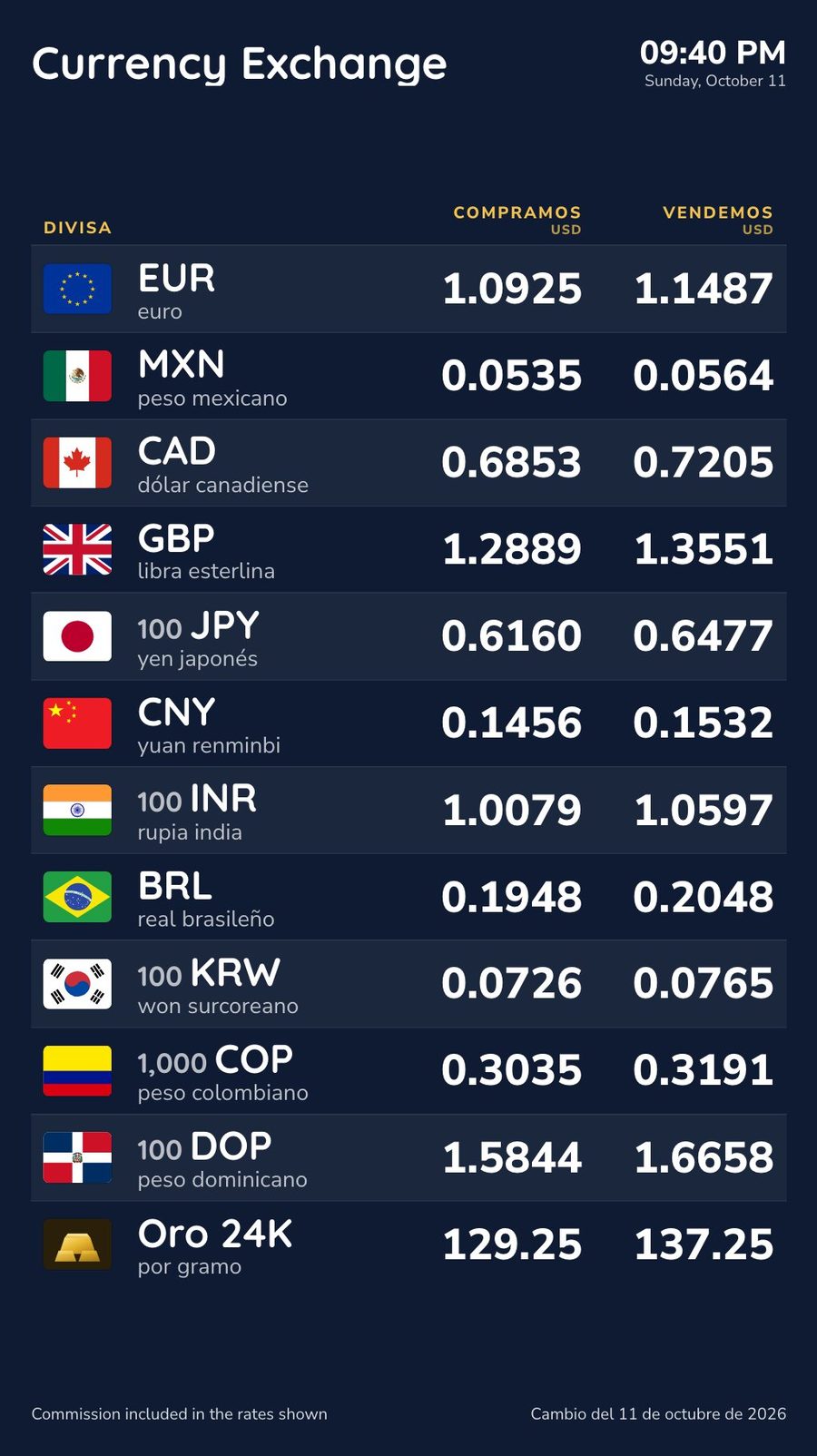
Pick a second language and the board switches between the two every six seconds: We Buy and Compramos, Euro and euro, Mexican Peso and peso mexicano. The labels come in 14 languages: English, Spanish, French, Portuguese, Chinese, Japanese, Arabic, Russian, Ukrainian, Polish, Turkish, Italian, German and Dutch.
Where the rates come from
Each currency is automatic or locked.
Automatic rates start from official daily reference rates and apply your buy and sell margin, in percent, per currency. For the dollar against the euro, the pound, the yen, the Canadian dollar, the Mexican peso and about 25 more, the reference comes directly from the European Central Bank. For the rest, gold and silver included, it comes from other central banks through the open-source Frankfurter service. easyCMS checks every hour, so the morning’s rates reach the screens without anyone touching them. Buy rates round down and sell rates round up, to the decimals you choose.
Locked rates stay exactly as you type them. That suits a store that prices from its wholesale bank or reprices through the day: lock every rate at today’s values with one button, adjust, and save. You change rates in Studio from a phone or a computer, and the screens show them within a few minutes. If the internet drops, the screens keep the last rates they received.
The free exchange rate margin calculator shows what a margin does to your rates before you set it.
Several stores, one place
Every store runs from one account. Stores can share one rates table or keep one each, with their own currencies and margins, and every screen shows the table you pick for it. A mall kiosk and an airport store can price differently and still be managed from the same Rates page.
Switch on “On your website” and Studio gives you a link and a short piece of code: a page with your current rates that you link to from Google Business Profile or put inside your own site, updated by itself from the same table as your screens.
What the rules ask of your board
We found no federal rule that says what a currency exchange rate board must show, and none in the states we checked (Florida, Texas, New York and California) that requires the rates to be posted. The rules are about who may exchange currency, and about not misleading customers:
- FinCEN registration. A business that exchanges more than $1,000 of foreign currency for any person on any day is a money services business as a dealer in foreign exchange (31 CFR 1010.100(ff)(1)) and registers with FinCEN within 180 days, renewing every two years (31 CFR 1022.380).
- Bank Secrecy Act duties. Currency transaction reports above $10,000, records of exchanges above $1,000 kept for five years (31 CFR 1022.410), suspicious activity reports from $2,000, and a written anti-money-laundering program.
- State licensing varies. Florida requires a license to exchange foreign currency (Fla. Stat. 560.303), and Texas licenses currency exchange under Finance Code chapter 152, with a Department of Banking complaint notice that must be posted where you serve customers (7 TAC 33.51). New York and California do not license in-person exchange of one currency for another on its own. Check your state’s regulator.
- No misleading claims. Section 5 of the FTC Act forbids deceptive practices. A “no fee” or “0% commission” sign when your margin is in the spread is the obvious risk; say the fee is included in the rates instead. Studio warns you if you type “0% commission”.
In practice: show a We Buy and a We Sell rate for each currency, keep the board and the register in step, put any fee or card surcharge next to the rates, and keep your state’s notices posted. This is not legal advice. For the rules in Europe and the UK, where boards are regulated, see the exchange rate display rules by country.
What it costs
easyCMS licenses are paid once and sold in euros; your card converts them. The dollar amounts below use the ECB rate of October 9, 2026 (1 EUR = 1.1206 USD) and are approximate.
One store, two screens
A portrait screen in the window and a landscape screen at the counter.
| Line | Cost |
|---|---|
| easyCMS account, up to 5 displays, includes 1 license | 49 EUR (about $55), once |
| 1 × extra license at 66 EUR, bought in the same order | 66 EUR (about $74), once |
| Software total, paid once | 115 EUR (about $129) |
The currency board, the Rates page, gold and silver, the website table and the automatic rates are included. The screens need something to play on: Windows player software is free, and LG webOS and Samsung Tizen commercial screens run the player inside the panel. See the pricing page for every option.
Compared with a monthly currency app
On the vendors’ own pricing pages in October 2026, Pickcel’s currency board was 13.50 to 15 USD per screen per month, ScreenCloud’s plans 20 to 30 USD per screen per month, and ForexBoard, a currency app with margins, 19.99 to 99.99 USD a month.
| easyCMS | $14 per screen per month | |
|---|---|---|
| Year 1 | about $129 | $336 |
| Five years | about $129 | $1,680 |
For the two-screen store above.
Several stores
Nine screens across three stores, on one account: a PRO account at 299 EUR (up to 25 displays, includes 1 license) plus eight licenses at 66 EUR in the same order is 827 EUR, about $927, once.
What easyCMS will not do
- Live market rates. The automatic rates are daily official reference rates. If you reprice against the market during the day, lock your rates and type them.
- Connect to your point-of-sale or compliance software. Rates are set in Studio. There is no import from your POS, and no CTR or SAR filing.
- Drive an LED number board. The ticker runs on an LED strip through a player, but numeric boards with fixed digits need their own controller.
- Bill in dollars. The shop sells in euros; your card or bank converts.
- Give legal advice. Check licensing and notices with your state regulator.
For the full feature tour, see exchange rate board software for currency exchange offices.