
A shop has more competing surfaces than almost any other kind of space: the window, the shelf edge, the queue, the till, the stockroom door. Retail signage works when each screen has one job and one audience, and stops working the moment it becomes a slideshow nobody has updated since opening week.
This page covers what earns its place on a retail screen, how to beat daylight in a shop window, how to change a price without opening a design tool, and what a three-screen shop and a twenty-store chain pay over five years. For the shorter background read, see our overview of digital signage for retail.
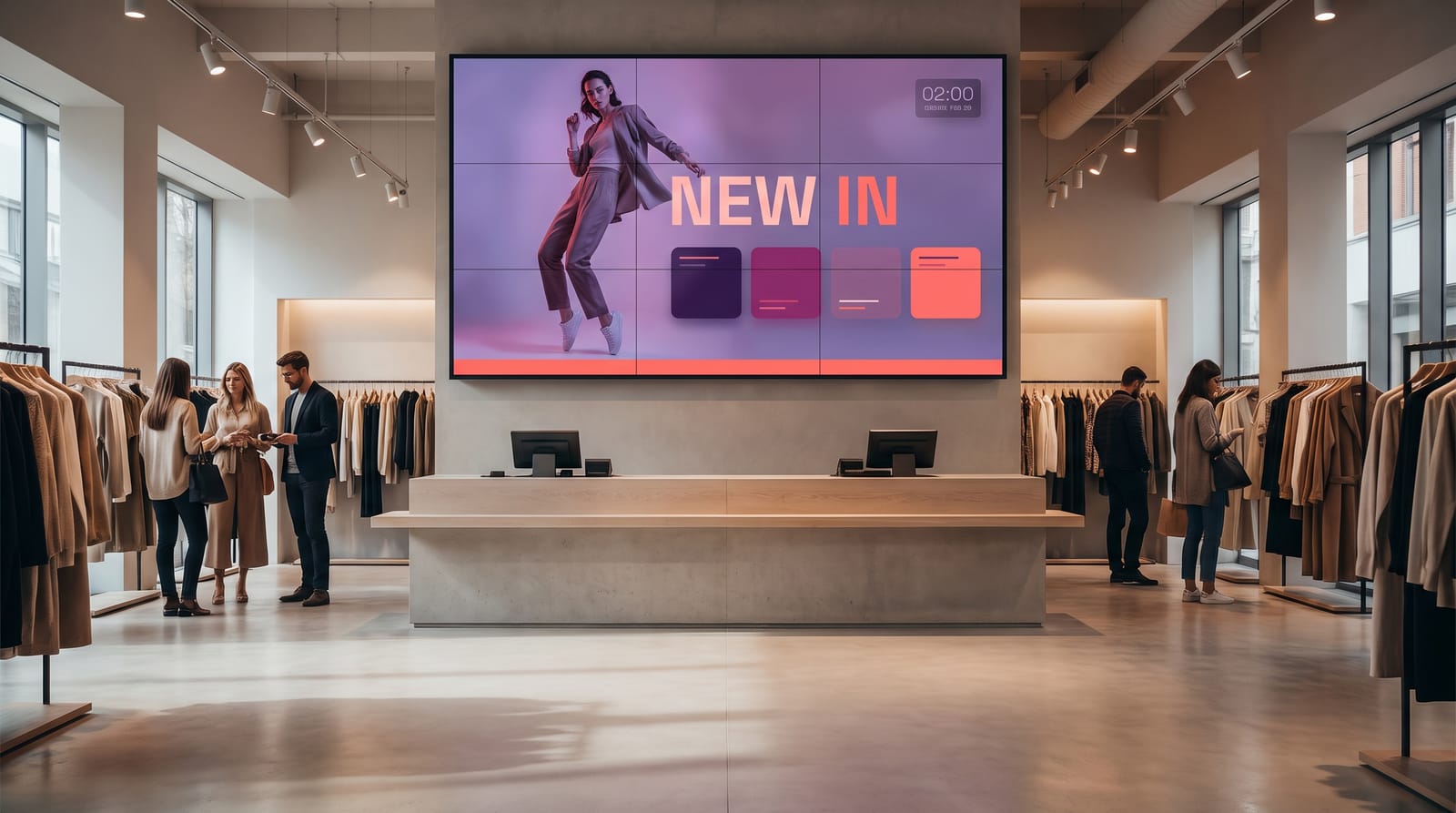
The advantages
- Change a promotion in every store in one action
- Swap window content by time of day without staff involvement
- Drive prices and offers from a table, not from a redesigned layout
- Cut the cost and lead time of printed point-of-sale material
- Keep playing when the shop broadband drops
- Buy the licences once and keep them
What actually goes on retail screens
The window
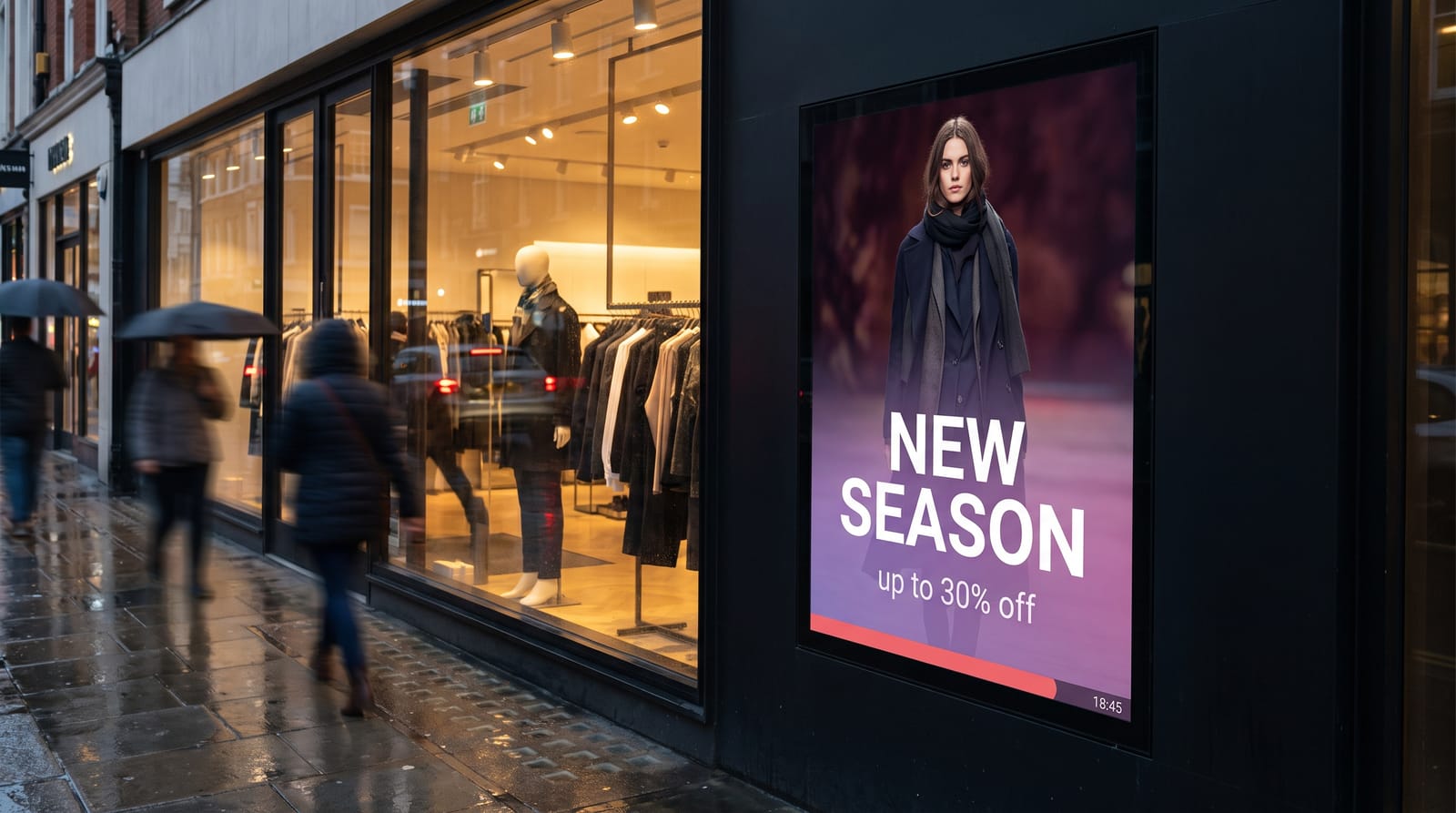
The window screen has to earn its money, because it talks to people who have not walked in yet. One message at a time, large, with a price or an offer and nothing else. Passing trade reads a window in about two seconds at walking pace, so a three-line headline is already too long.
Window content also changes more often than anything else in the store: the weekend offer, the sale, the new season, bank holiday hours. That frequency is why a screen beats vinyl and printed cards.
Promotions at the shelf and the end of the aisle
Smaller screens at the end of an aisle support a decision someone is already making. Two or three items from that category, with the price and one reason to buy, beat a brand video that has nothing to do with the shelf underneath it. Interactive content is available too, so buttons can jump to another layout: sizes, ingredients, care instructions.
The queue and the till
A queue is captive attention and the easiest place to test an offer. Put high-margin add-ons here, plus what people ask staff about anyway: loyalty scheme, returns policy, delivery, gift cards. A screen above a queue also shortens the perceived wait. If you sell food or drink over a counter, the same screens become digital menu boards.
Wayfinding in larger stores
Once a shop is big enough that customers ask staff where things are, a directory screen pays for itself in staff time. Keep it static and legible rather than animated, and put one at every decision point.
The back office
A stockroom or staff-room screen carries the day’s targets, the delivery schedule, rota changes, safety notices and the promotional calendar, so staff know what the customer-facing screens are saying. Keep staff content on staff screens: mixing a sales target into a customer loop makes both look unprofessional.
Tip What does not belong: long brand films, dense paragraphs, unmoderated social walls, and anything duplicating a printed sign that is already legible. A useful test before adding a slide is whether a customer can act on it in the next five minutes, in this shop.
The shop window problem
Most retail projects get this wrong, so it is worth being blunt. A screen in a window fights daylight, often direct sun, and an ordinary television looks grey and washed out from the pavement at exactly the hours you want it working.
There are two honest answers. A high-brightness commercial LCD, built for long duty cycles and rated for the heat that builds up behind glass: the detail is on our page about LCD displays for digital signage. Or, for a large window or a shopfront fascia, an LED display, which wins outright on brightness and on size flexibility.
Two easyCMS customers work in this field, which helps if you are sourcing hardware. Artixium is an LED display manufacturer that resells easyCMS to its own customers, and HTV LED is an LED specialist that outsources the CMS side to us. The MediaMarkt LED banners in Belgium and Luxembourg are HTV LED’s work, and the Santa Lucia checkout screens show the same CMS at the till of a supermarket.
Watch out A consumer TV in a sunlit window is the most common false economy in retail signage. It will look poor for half the trading day, and its warranty usually excludes commercial use.
Where to put screens, and what size
| Location | Suggested size | Orientation | Job it does |
|---|---|---|---|
| Shop window | 49”–75” high brightness, or LED | Portrait | Offer of the moment, passing trade |
| Entrance, inside | 43”–55” | Portrait | Welcome, current campaign, opening hours |
| End of aisle | 32”–43” | Portrait | Category offers, product detail |
| Above the queue | 43”–55” | Landscape | Add-ons, loyalty, policies |
| Till point | 24”–32” | Landscape | Payment options, returns information |
| Wayfinding point | 43”–55” | Portrait | Departments, floor plan, services |
| Stockroom or staff room | 32”–43” | Landscape | Targets, rota, deliveries, notices |
Keep the smallest text at roughly 1/25 of the screen height, which reads comfortably from three to five metres. Mount above head height wherever a crowd forms: a screen at eye level in a queue is a screen blocked by the person in front.
Dayparting: the same screen, four jobs
A window that shows one thing all day is doing a quarter of the work you paid for. Schedule it instead:
| Time | What plays in the window |
|---|---|
| Before opening | Opening hours, click-and-collect information, brand loop |
| 09:00–12:00 | Morning offer, new arrivals, quieter product loop |
| 12:00–14:00 | Lunchtime offer aimed at passing office trade |
| 14:00–18:00 | Main campaign, category promotion, sale messaging |
| After closing | Opening hours, website, delivery and returns |
You build this once and the player runs it seven days a week. Sale periods and seasonal campaigns can be scheduled weeks ahead and simply appear. Our guide to scheduling content covers dayparting, repeating events and campaigns.
Changing a price without redesigning anything
The failure mode in retail signage is that every price change becomes a design job. Somebody opens the layout, edits the text, saves it wrong, and three months later nothing is current.
DataSets fix this. A DataSet is a table inside the CMS, filled in by hand or imported from a CSV, with columns such as product, price, offer and end date. The layout points at the table, so when a price changes someone edits one cell and every screen showing that table updates on its next check-in. Head office maintains one table and every store shows it. The walkthrough is in dynamic content with DataSets.
Tag-based playlists do the same for images. Tag a set of product images “autumn-sale” and the playlist picks up anything you tag later, with no layout edit. Export each image at the pixel size of the zone it plays in: an oversized file costs storage and download time for no visible gain.
Rolling out across several stores
Be honest about which of these you are.
One shop, up to five screens. The easyCMS account at 49€ is the right tier: it includes one licence and manages up to five displays. Extra licences bought in the same order as the account are 66€ each, a third off, applied automatically at checkout with no code to enter, so a five-screen shop is 313€ paid once. Added later they are 99€ each, so the same five screens are 445€ at list. One login, shared by a manager or a small team, is genuinely fine at this size.
A few shops, up to 25 screens. The PRO account at 299€ covers up to 25 displays, adds proof-of-play reporting and raises storage to 5GB. Filled to 25 screens in a single order it is 1,883€ paid once, or 2,675€ if the screens are added later at the 99€ list price. Group displays by store, schedule to the group, and push a campaign everywhere in one action.
A chain, or anything needing separate logins per branch. Users, user groups, roles and permissions are Enterprise features. If the area manager for the north should publish to the north only, or store staff should edit one panel and nothing else, that is the Enterprise account at 1290€ a year. Enterprise also brings full white label on your own domain, which matters for franchises and resellers, and drops Android players to 299€. Enterprise licence pricing depends on the platform: Android, LG webOS and Samsung Tizen displays are 49€ each, and Windows and Linux displays carry no licence charge at all. Android, webOS and Tizen players run a commercial player licence that easyCMS buys in, while the Windows and Linux player software is free.
Good to know On the 49€ and PRO accounts there is one login for the account. If several people need their own accounts with different rights, Enterprise is the tier that provides it.
Measuring it
Proof-of-play reporting, included with PRO and Enterprise, records what played on which display and when. That gives you a log for a supplier who has paid for placement, and it tells you whether the screen at the back has been dark for a fortnight.
Display monitoring shows each screen’s last check-in, its connectivity, and an on-demand screenshot of what is playing. For a chain that screenshot is the feature you will use most: it answers “is the Manchester window showing the new campaign” without phoning Manchester.
What it costs: two worked examples
A three-screen independent shop
One window screen, one end-of-aisle screen, one above the till.
| Line | Cost |
|---|---|
| easyCMS account, 1 licence, up to 5 displays, 1GB storage | 49 EUR one-time |
| 2 × extra licence at 66 EUR, same order as the account | 132 EUR one-time |
| Software total, paid once | 181 EUR |
There is no year two, no renewal and no per-screen fee. The 66 EUR licence price is the automatic discount for buying the licences alongside the account. Added later they are 99 EUR each, so the same three screens are 247 EUR at list.
A twenty-store chain
Twenty stores, three screens each, sixty displays, with separate logins for head office and regional managers. Above 25 displays and needing per-user permissions, that is Enterprise. The figures below assume Android players or Android-based commercial screens, the usual retail choice. On Windows or Linux players there is no Enterprise licence charge at all, which makes that route cheaper.
| Line | Cost |
|---|---|
| Enterprise account, 20GB storage, white label, users and roles | 1,290 EUR per year |
| 60 × Android licence at the Enterprise price of 49 EUR | 2,940 EUR one-time |
| Year one | 4,230 EUR |
| Each year after | 1,290 EUR |
| Five-year total | 9,390 EUR |
Run the same sixty screens on Windows or Linux players and the licence line is zero: 1,290 EUR in year one and 6,450 EUR over five years. Enterprise is the only easyCMS plan that recurs. Everything else on the pricing page is bought once.
Compared with per-screen subscriptions
Almost every other platform charges per screen per month. These are the vendors’ own published list prices, checked September 2026, in the currency each one quotes:
| Platform | Entry plan | Higher plan | Free tier |
|---|---|---|---|
| Yodeck | Basic $8 / 8 EUR per screen per month | Premium $12 | Yes, 1 screen forever |
| OptiSigns | Standard $10, or $9 annual / 7.50 EUR | Pro $12.50, Pro Plus $15 | Yes, 3 screens, their logo on screen |
| ScreenCloud | Core $20 per screen per month, annual | Pro $30 | No |
| TelemetryTV | Entry $8 per device per month | Core $13, Elite $16 | No |
| Rise Vision | Business Basic $12 per display per month | Business Advanced $14 per display per month | No |
| digitalsignage.com | mediaCLOUD+ $3.00 per screen | Not listed | Yes, up to 3 screens |
| Xibo Cloud | Cloud Professional 4,40€ per display per month | Business 6,90€, Enterprise 11,30€ | No |
The honest framing is break-even, not percentages, and the shape of the line matters more than the first invoice. easyCMS is paid once and then flat. A subscription keeps billing for as long as the screen is on the wall.
Take the three-screen shop above. It pays 181€ and nothing after that. The same three screens on one of the cheapest credible paid tiers, 8 EUR per screen per month, cost 288 EUR a year: 864 EUR by the end of year three and 1,440 EUR by the end of year five. easyCMS is level with that subscription after about eight months and free of it from then on. Added later at 99€ a licence the shop is 247€, which is level at about ten months.
The sixty-screen chain pays 4,230€ in year one and 1,290€ a year after that: 6,810€ by the end of year three and 9,390€ by the end of year five. The same sixty screens at 8 EUR per screen per month are 5,760 EUR a year, 17,280 EUR by year three and 28,800 EUR by year five. The first year’s outlay is matched at about nine months. On Windows or Linux players, where Enterprise charges nothing for licences, it is matched in under three months.
Screen by screen against the same rate: a first easyCMS screen pays for itself in roughly six months, each further licence bought in the same order as the account in about eight months, and a full 25-screen PRO build at 1,883€ in about nine months. At the 99€ list price those become roughly twelve to thirteen months for a licence and thirteen to fourteen months for a 25-screen build at 2,675€.
Two concessions, plainly. Yodeck and OptiSigns have real free tiers, so if you need one screen, or three with a logo on them, free beats 49€. And Rise Vision’s per-school unlimited plan is better value at very high screen density in a single building. The working is in our cost per screen guide and on digital signage with no monthly fee.
What you need to buy
- A display. Commercial LCD indoors, high brightness for the window, LED for large or sun-facing frontage.
- A player, unless the screen has one built in. easyCMS runs on Windows, Android, LG webOS and Samsung Tizen, and an LG or Samsung commercial screen runs the player inside the panel. See players for easyCMS and the player buying guide.
- A licence, one per screen. On the 49€ and PRO accounts every screen needs one whatever it runs on: 66€ in the same order as the account, 99€ afterwards. On Enterprise the price depends on the platform, because Android, webOS and Tizen carry a commercial player licence that we buy in while the Windows and Linux player software is free: 49€ for Android, LG webOS and Samsung Tizen, and no charge at all for Windows and Linux.
- A mount, rated for the panel weight and for portrait if you mount portrait.
- Power and network behind the screen. Ethernet where you can, Wi-Fi where you cannot.
If you would rather not source it, an easyCMS Android player is 499€, or 299€ on Enterprise, arrives pre-configured and includes one display licence. It needs no separate display licence: the player is hardware and does not replace a licence line. A premium HDMI cable is 29€ and a wireless keyboard is 39€.
What easyCMS will not do
Retail buyers ask for these, and the answer is no. Better here than after you have spent money.
- No till or POS integration. Prices reach the screens through a DataSet someone maintains or imports as a CSV, not from a live EPOS feed.
- Proof of play is not sales attribution. It records what played and when. Comparing that against till data is a manual job.
- No charts widget. You can embed a dashboard such as Power BI as an add-on, or show a webpage, but there is no native chart builder.
- No app marketplace and no templates gallery. You build layouts in the editor, or we build them with you.
- No multi-user access below Enterprise.
- Synchronised video walls are Android only.
- No native mobile app. The CMS runs in a browser, which works on a phone, but there is no dedicated app.
Running it day to day
Who updates it. In a single shop, the manager, in about ten minutes a week. In a chain, one marketing person owns the campaign calendar and the DataSets. Window content changes weekly or per campaign, aisle and till content monthly, prices whenever they change, staff screens daily.
Storage. 1GB on the 49€ account, 5GB on PRO, 20GB on Enterprise. Retail video eats that quickly, so compress before uploading and delete what you no longer run. See storage quota and media uploads.
Network. Players pull content over an encrypted connection and accept no inbound connections, so no inbound port needs opening on a store router, and every display must be authorised in the CMS first. Content is cached on the player, so a broadband outage does not blank the window. More in digital signage without internet.
Getting going. Connect your first display, then build from a template in creating layouts. The features page lists what is available.
Questions retailers ask
Can I run the same promotion in every store at once?
Yes. Group displays by store or by screen type, then schedule to the group. One action changes every window in the estate.
How do I change a price?
Edit one cell in a DataSet. The layout reads the table, so nothing is redesigned and no image is re-exported.
Do I need a licence for every screen?
Yes, one per screen, one time. Two panels side by side showing halves of one window design still need two licences.
Is there a monthly fee?
No. Accounts and licences are one-time and lifetime. The only recurring plan is Enterprise, and that is billed yearly.
Is there a free trial?
No. There is no free plan and no free trial. The entry point is the 49€ account, a one-time payment that includes one display licence and manages up to five displays. Further screens bought in the same order as the account are 66€ each, and 99€ each if you add them later.
Can we put it on our own domain with our branding?
That is white label, part of the Enterprise account. Franchises and resellers usually want it.
Where to start
Count your screens, mark which ones face daylight, and decide whether you need one login or several. Those three answers settle your tier and most of your hardware. Send us the list and we will come back with a figure, and a VAT invoice for your finance team. Email info@myeasycms.com, call +48 509 937 137 Monday to Friday 09:00 to 17:00 CET, or use the support request form.