
Our digital signage software is perfect for restaurants and bars. It allows you to easily and quickly broadcast multimedia content. Use it for showing off promotions, the dish of the day, full menus and your social feeds, and change any of it from your phone between services.
This page is a practical guide: what to put on screen in a food and drink venue, where to hang the screens, what a typical site actually costs over five years, and how to keep the whole thing running without adding a job to anyone’s shift.
The advantages
- Give a modern image to your restaurant
- Reduce the perception of customers waiting
- Inform your customers about the promotions of the day
- Highlight your products easily
- Reduce paper printing costs
- Schedule promotions in advance
What actually goes on the screens
The mistake most venues make is treating a screen as a slideshow. A screen earns its place when it does a specific job at a specific moment of the day.
Menu boards
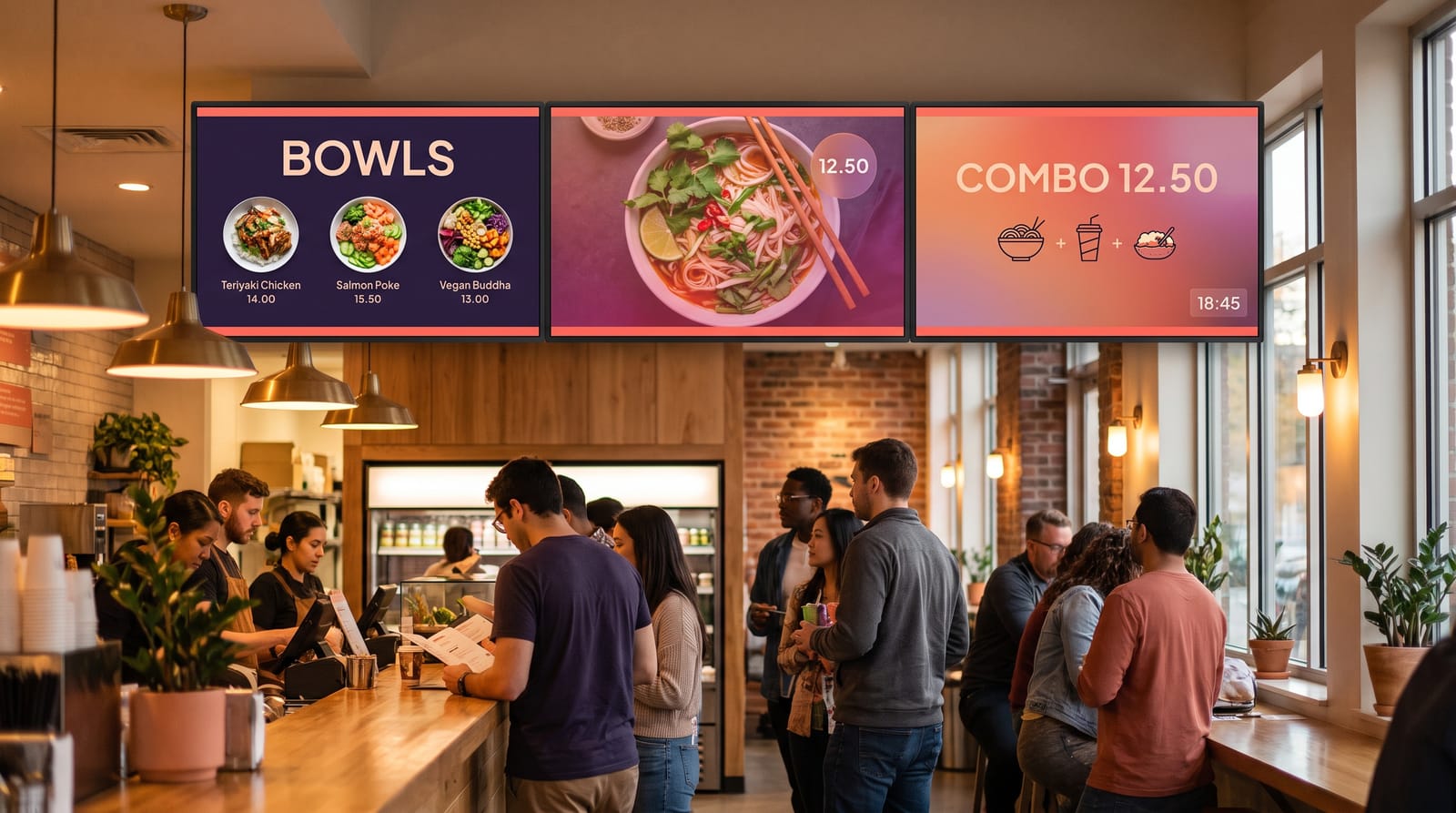
The core use. A digital menu board replaces the printed board above the pass or behind the bar. Two or three landscape screens side by side usually work better than one large one: you get a natural split into starters / mains / desserts, or food / drinks / specials, and you can change one panel without redesigning the whole board.
Keep prices in a single aligned column, use one clear typeface, and leave real space between lines. A board that a customer reads in eight seconds from four metres away beats a beautiful one that nobody can parse in a queue.
Dayparting: breakfast, lunch, dinner, late
This is the feature that pays for the screens. Instead of one menu compromising between breakfast and dinner, you schedule a different layout to appear automatically:
| Time | What plays |
|---|---|
| 07:00–11:00 | Breakfast board, coffee menu, takeaway offers |
| 11:00–15:00 | Lunch menu, dish of the day, set-lunch price |
| 15:00–18:00 | Afternoon menu, cakes, aperitivo teaser, quieter loop |
| 18:00–23:00 | Dinner menu, wine list, dessert board |
| 23:00–close | Late drinks, last orders, opening hours for tomorrow |
You set this once. The player switches over on its own, seven days a week, without anyone touching a laptop. Our guide to scheduling content walks through building a daypart schedule step by step.
Specials, 86’d items and price changes
When the kitchen runs out of the sea bass, someone crosses it off a printed board with a marker, or doesn’t. On screen, a manager can hide the item from their phone in a few seconds. The same applies to a supplier price change, a new dish, or a happy-hour price that only applies between 17:00 and 19:00.
Allergen and dietary information
Screens are a good place for vegetarian, vegan, gluten-free and allergen markers because you have room to be legible about them. Use consistent icons next to dish names, and keep a static panel pointing customers to the full allergen list and to a member of staff. Screens support your existing process here; they do not replace the printed allergen documentation your local rules require.
Upsells and margin
The highest-margin items should get the most screen time: side dishes, desserts, coffee, cocktails, a second round. A short rotating “add to your order” strip along the bottom of the menu board is one of the easiest things to test, run it for two weeks, look at the till data, keep what worked.
Wait times and queue management
At a counter, a screen that shows the current wait or an order number changes how long the wait feels. Even a simple rotating loop above the queue makes people look up instead of at the back of someone’s head.
Terrace, weather and atmosphere
A screen facing a terrace or window can carry the weather, today’s cocktail, the football fixture you are showing, or live opening hours. Inside, a quieter screen in the bar area can run brand video, the playlist you are playing, or your Instagram feed. Match the content to the mood of the room, not to the biggest screen you own.
Where to put screens, and what size
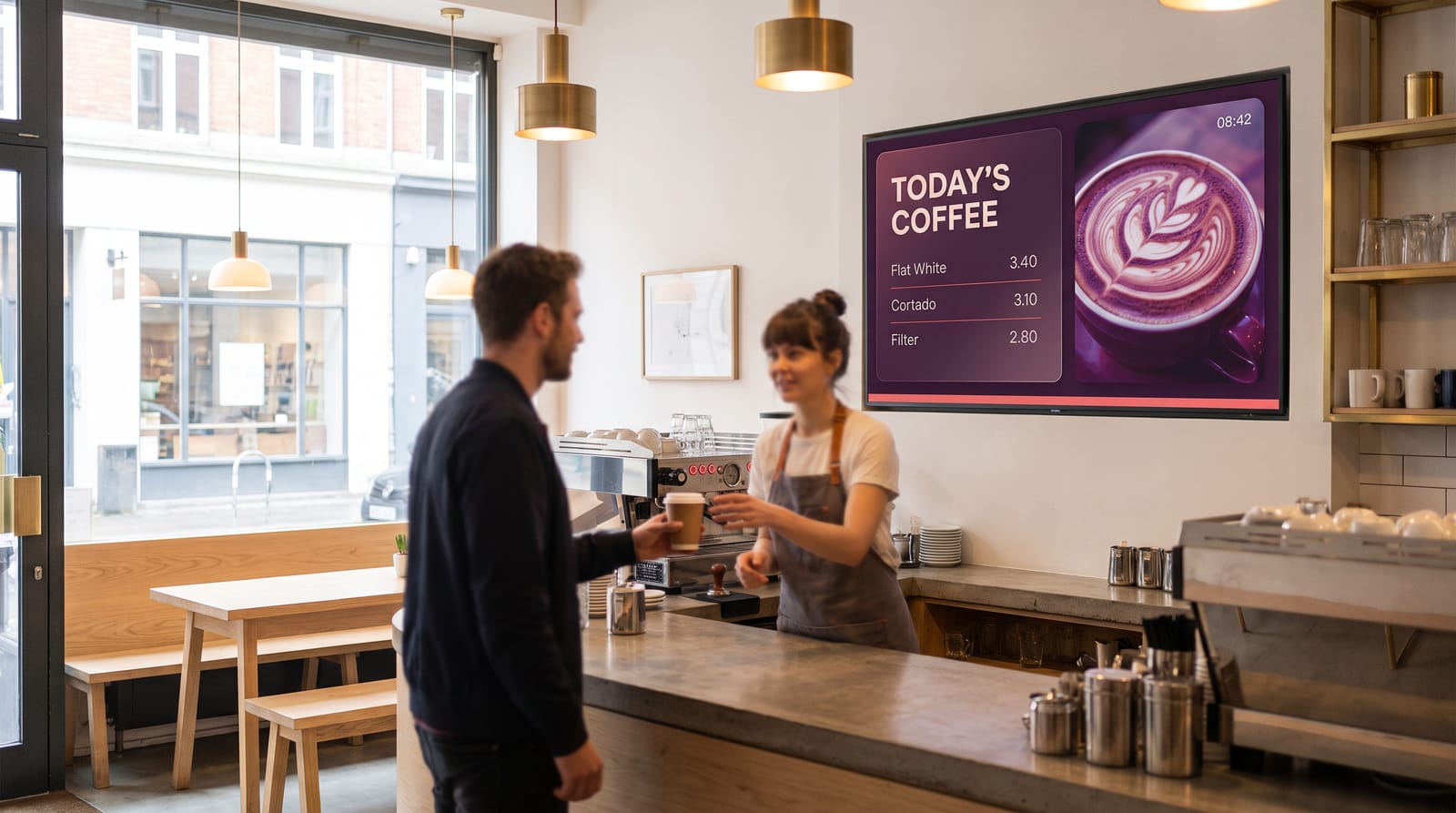
Digital signage for restaurants and bars is an effective solution to improve your communication. You can place several screens in your establishment and then manage the content in groups or separately according to your needs. Some screens can display drinks, others dishes depending on their location in the establishment.
| Location | Suggested size | Orientation | Job it does |
|---|---|---|---|
| Above the counter / pass | 2–3 × 43”–55” | Landscape | Main menu board |
| Entrance or window | 43”–55” | Portrait | Today’s offer, opening hours, passing trade |
| Behind the bar | 32”–43” | Landscape or portrait | Drinks, cocktails, happy hour |
| Terrace-facing | 49”–55” high brightness | Landscape | Weather, specials, fixtures |
| Waiting area | 43” | Portrait | Wait times, brand video, social feed |
Two rules of thumb worth applying. First, the smallest text on screen should be roughly 1/25 of the screen height for comfortable reading at three to five metres, on a 55” screen that is about 27 mm tall. Second, mount so the middle of the screen sits at about 1.6 m from the floor unless people will be looking up from a queue, in which case go higher and tilt down.
Almost all restaurant work is indoor LCD. If you want the technical detail on panel choice, see our guide to LCD displays for digital signage; if you are putting something in a window or facing a car park, LED displays are the other option.
What it costs: a worked example
Take a 60-cover restaurant with a bar. Five screens: three menu boards above the pass, one portrait screen in the window, one behind the bar.
With easyCMS you buy licences once and keep them:
| Line | Cost |
|---|---|
| easyCMS account, includes 1 licence, up to 5 displays, 1GB storage | €49 one-time |
| 4 × extra licence at €66, bought in the same order | €264 one-time |
| Software total, paid once | €313 |
Good to know Licences bought in the same order as the account are €66 each instead of €99, a third off. It is a discount applied automatically at checkout, so there is no code to enter. Screens added later are €99 each, which would make the same five-screen network €445 at list.
There is no year two. Now compare that with a per-screen subscription. Subscription platforms typically sit somewhere between €15 and €25 per screen per month; we have used €20 here, so swap in whatever quote you have in front of you.
| easyCMS | Subscription at €20/screen/month | |
|---|---|---|
| Year 1 | €313 | €1,200 |
| Year 2 | €0 | €1,200 |
| Year 3 | €0 | €1,200 |
| Year 4 | €0 | €1,200 |
| Year 5 | €0 | €1,200 |
| Five-year total | €313 | €6,000 |
At €100 a month for five screens, the subscription passes €313 in the fourth month, so the easyCMS side has paid for itself in a little over three months and then stays flat. By the end of year three you are €3,287 ahead, by the end of year five €5,687, which is roughly €12.52 per screen per year with easyCMS against €240 per screen per year on subscription. If you run a second site, the gap doubles.
If you add the four extra screens later rather than in the opening order, they are €99 each and the same network is €445, still €5,555 less than five years of subscription and €17.80 per screen per year. We break the maths down further in our guide to digital signage cost per screen.
Two optional lines to be aware of. If you want the hardware supplied too, an easyCMS Android player is €499 and arrives pre-configured, but it still needs a display licence of its own, so it is a line on top of the licence rather than a replacement for one. The guides and the assistant are free to everyone, and an expert hour is €25 if you want someone hands-on.
Running more than five screens across two or three sites? The PRO account is €299 one-time and covers up to 25 displays with 5GB of storage and proof-of-play reporting. The same one-order discount applies to it, so ten screens bought together is €299 plus 9 × €66, €893 in total. Full details on the pricing page.
Running it day to day
Who updates it. In most venues, one person, a manager or an assistant manager, owns the screens, and it takes about ten minutes a week. Building a new seasonal menu takes longer the first time; after that you are editing text in an existing layout.
How often. Menus change seasonally. Specials change daily. Prices change rarely. Build the layouts so the daily edits are text-only and the seasonal edits are the ones that need design.
Who needs access. Give the general manager full access, give shift supervisors permission to edit the specials and 86’d items only, and leave everything else locked. That way the person who needs to pull a dish at 19:30 can do it without being able to break the menu board. Head office can keep control of branding and prices across every site.
Multi-site. Content is managed centrally. Push the same brand campaign to every venue at once, then let each site override its own specials panel. Grouping displays means a change to “all drinks screens” hits every bar in the estate in one action. Fritapapa runs twenty restaurants that way, one promotional screen each, from one account.
Layouts. Start from a pre-configured layout and adapt it; see creating layouts for the walkthrough, and connecting your first display to get a screen live.
Hardware notes for kitchens and bars
Food service is a hostile environment for electronics, and it is worth spending five minutes on this before you buy.
- Heat and grease. Do not mount a screen directly above a fryer, grill or pass where hot air rises into the vents. Airborne grease coats vents and fans and shortens panel life. Keep screens out of the plume, or at minimum well to the side of it.
- Commercial panels, not TVs. A consumer TV is rated for a few hours a day and its warranty usually excludes commercial use. A commercial panel is rated for 16/7 or 24/7 running and is brighter, 350 to 700 nits against roughly 250 to 350 on a domestic set. If a screen faces a window, you want the brighter end.
- Portrait mounting. Only mount a screen in portrait if the panel is rated for it. Commercial panels usually are; consumer TVs frequently are not, because the thermal design assumes landscape.
- Cleaning. Screens in food areas get cleaned. Specify panels you can wipe down, and site the player behind the screen or in the back office rather than on a shelf that collects splashes.
- Power and cabling. Run power and network behind the wall where you can. Where you cannot get Ethernet, Wi-Fi is fine, the player caches content locally, so scheduled content keeps playing even if the connection drops mid-service. That is covered in more detail in digital signage without internet.
- Players. easyCMS runs on Windows, Android and LG webOS. An LG commercial screen with webOS built in needs no separate box at all. See the player buying guide to choose.
Custom Layout
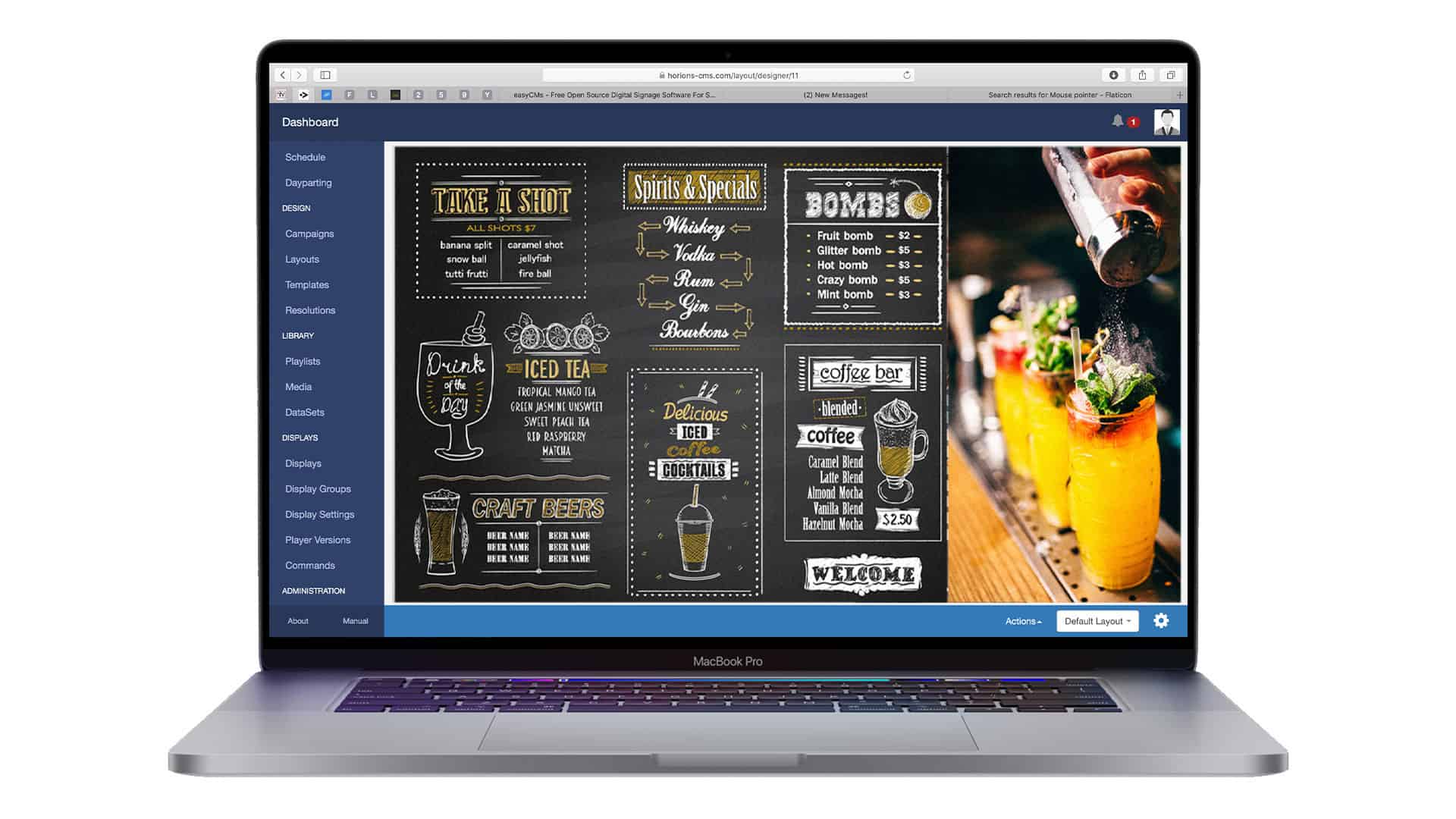
Content is king! Indeed the acquisition of an LCD screen and a Digital Signage solution is only the beginning. Fuelling your screen with quality content on a suitable digital layout is the key to success. Our experience in creating content for digital signage is put to your benefit. You can use pre-configured layouts or we can create one as needed. If you wish, you can even create the layout yourself.
Questions restaurants ask
Can I change the menu from my phone?
Yes. The CMS runs in a browser, so you can edit a price or pull a dish from your phone in the office or at home and the screens update the next time the player checks in.
What happens if the Wi-Fi goes down mid-service?
Nothing visible. Content is cached on the player, so whatever is scheduled keeps playing. When the connection returns the player picks up any changes you made in the meantime.
Do I need one player per screen?
One licence per screen, yes. If two screens sit side by side showing halves of the same menu board, each still needs its own licence. Some commercial screens with webOS built in run the player inside the screen, so there is no extra box.
Can I run different menus in different rooms?
Yes. Group your displays, bar, restaurant, terrace, and schedule content per group. The same account manages all of them.
Is there a monthly fee?
No. Licences are one-time and lifetime. There is no recurring cost at all unless you move up to the yearly Enterprise account.
Get your menus on screen
Work out how many screens you need, tell us where they are going, and we will tell you what it costs, including whether you are better off with your own hardware or with pre-configured players. There is no subscription to talk you out of later.
Email info@myeasycms.com, call +48 509 937 137, or use the support request form. You can also read what digital signage is, look at what other customers have built, browse the full feature list, or read up on free digital signage software.