
A plant already has its numbers. They are on a whiteboard by the line, in a spreadsheet on the shift manager’s laptop, and in a system three people have a login for. Screens do not create those numbers. They carry them to the people who can act on them, without anyone walking the floor with a marker pen at the end of every hour.
This page covers what earns a screen in a factory, warehouse or depot, the two honest ways to get a changing number onto one, how the network side behaves on a segmented plant network, and what six or thirty screens actually cost.
What goes on the screens
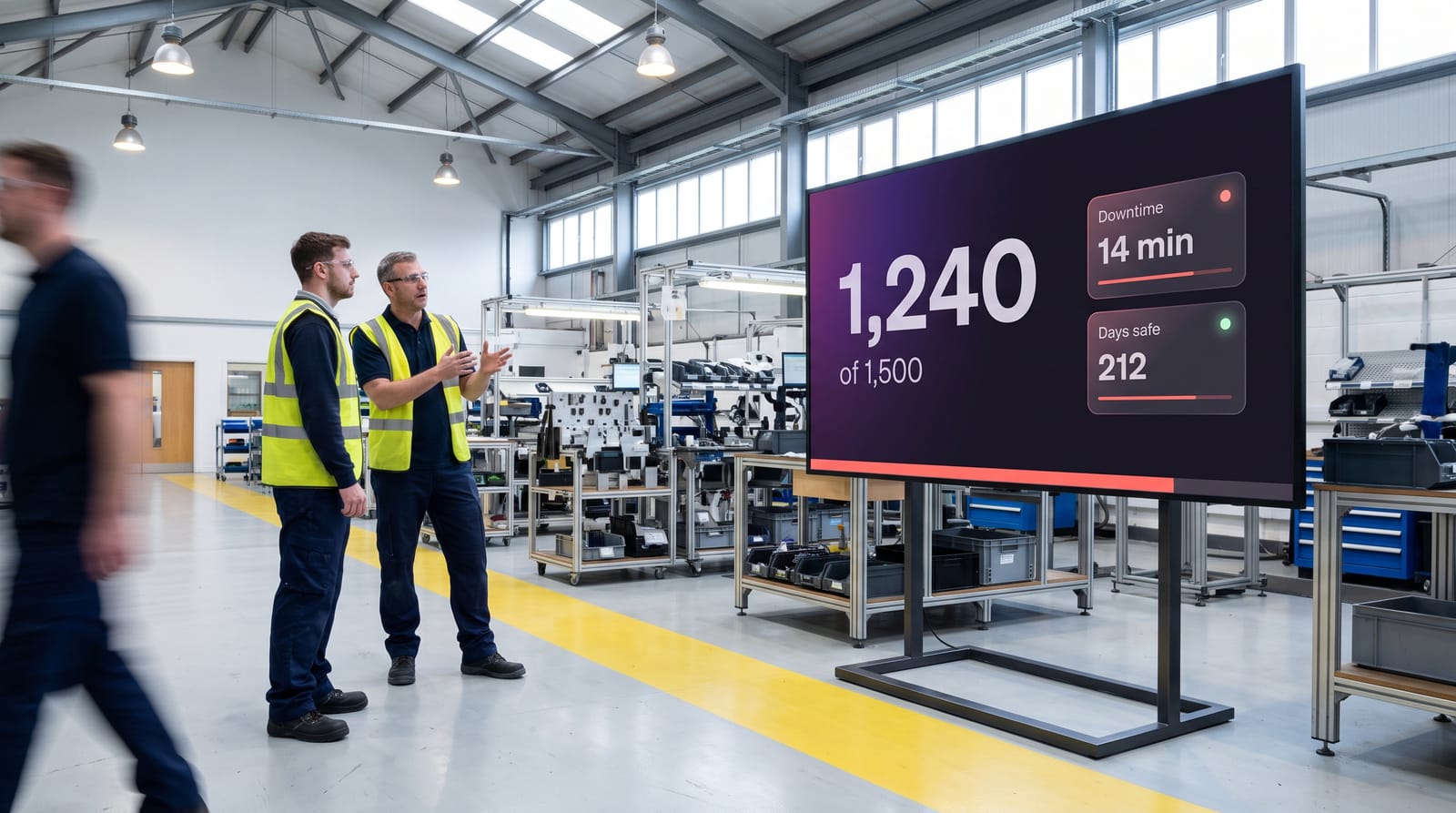
Production and OEE boards. Target against actual for the shift, units per hour, the current downtime reason and how long it has run, scrap rate, OEE split into availability, performance and quality. One rule matters more than the rest: one number is the number. A board carrying thirty tiles gets ignored within a week. Make the metric the shift is judged on readable from the far end of the cell, and put supporting detail underneath at a quarter of the size.
Safety and days since last incident. A days-since counter, held as a date in a DataSet or a field the safety lead updates, alongside the site safety message, this month’s near-miss theme and PPE rules for the area. Safety content works best when it is not permanent wallpaper, so rotate the message monthly.
Shift information and handover. Who is on which cell, cover for absence, agency briefing, weekend overtime, maintenance windows, notes from the shift that just finished. A screen at the clock-in point reaches everyone entering the building, which is more than a sheet in the crew room manages.
Quality alerts. A defect found on the line, a batch on hold, a rework instruction. These need to reach the right screens within minutes and disappear when the issue closes, which is what a scheduled override layout is for.
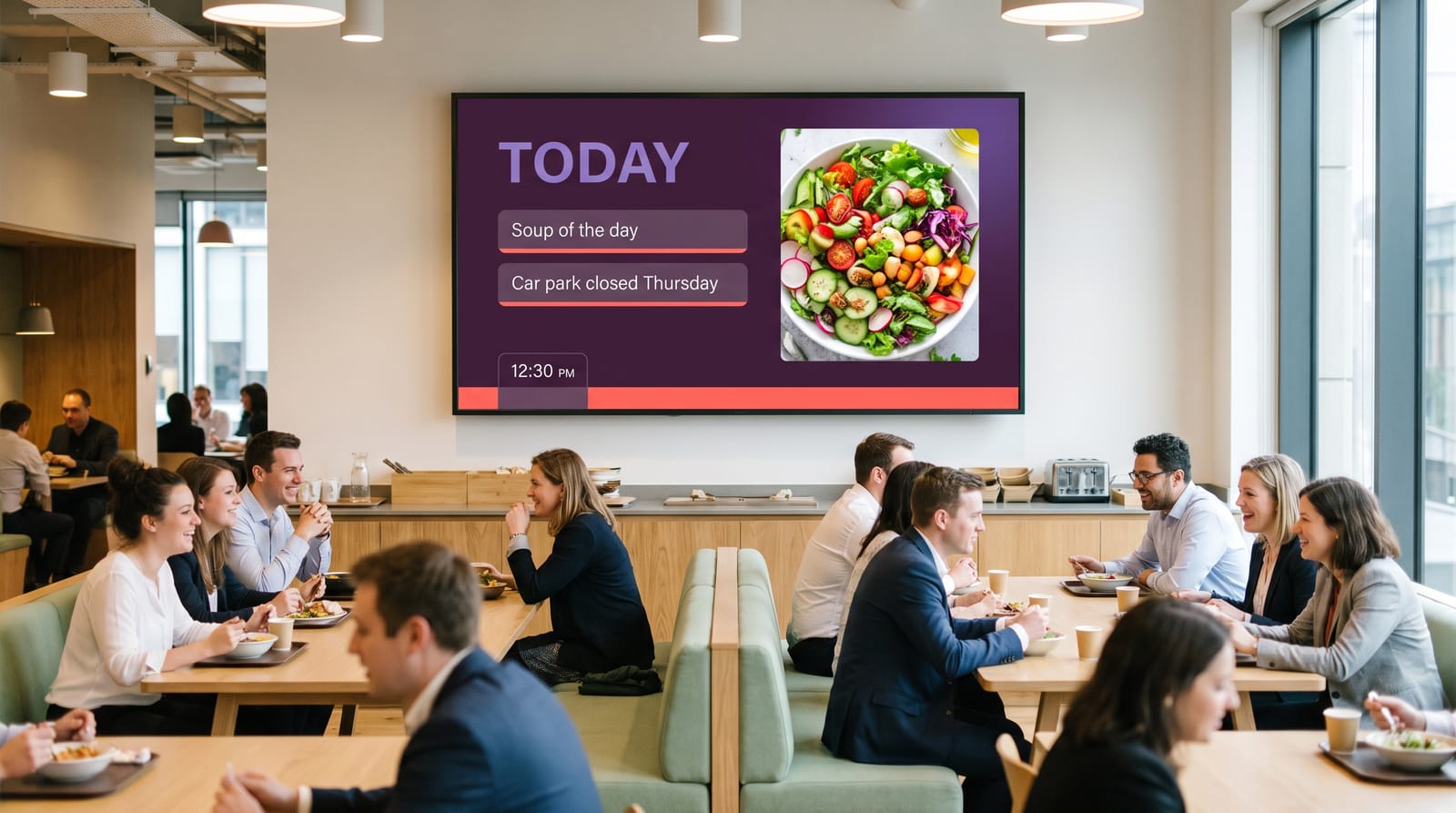
Canteen and welfare areas. The canteen is where the workforce stops moving. Company news, new starters, training dates, works council notices, menus, language versions for a mixed workforce. Our guide to digital signage for internal communication covers that content in more detail.
Goods-in and reception. Site rules, PPE requirements, the sign-in process, today’s expected deliveries and contractors. Almost every visitor to a plant is a first-time visitor, so the screen gets read.
All of that is ordinary scheduled content. The next two sections decide whether a plant project works.
Getting a live number onto a screen, honestly
There are two routes with easyCMS. Both are real, and both have a catch worth knowing before you buy screens.
Route one: a DataSet
A DataSet is a table inside the CMS. You define the columns, such as line, target, actual and downtime reason, and the layout points at that table. When the values change, the screen changes. Nobody edits a layout and nobody redesigns anything, and one layout can serve six lines by filtering on a column.
Values get into the table one of two ways: someone types them in, or you import a CSV. That CSV can come from whatever produces your numbers today, an export from a production system, a shared spreadsheet the team leader keeps, or a small script. The walkthrough is in dynamic content with DataSets.
Tip Keep the DataSet flat and boring. One row per cell, one column per value, no merged concepts. The moment a column holds “1,240 of 1,500 (83%)” as text, you can no longer colour the cell red when it falls behind.
Route two: show a dashboard you already have
If your managers already trust a dashboard, the webpage widget puts it on screen, and the HTML package widget hosts a small self-contained page you supply. Power BI dashboards are available as an add-on. This is the fastest route when the reporting work is already done. See webpages and embedded content.
The part nobody documents: authenticating an unattended player
A player is a browser with nobody sitting at it. If the dashboard needs a login, an identity-provider redirect, or multi-factor authentication, then sooner or later the session expires and the screen above the line spends the night showing a sign-in page. This is what kills most factory dashboard projects. The workable answers, in order of preference:
- A read-only “publish to web” or anonymous view URL, if your reporting tool offers one.
- A page served inside the plant network that trusts the player’s IP address, with no login.
- A tokenised URL. Treat the token as a password, because anyone reading the address bar has your data.
- A read-only account whose session does not expire, agreed with IT as an exception.
Watch out easyCMS has no SSO or SAML support and no public API portal. If your dashboard can only be reached through your corporate identity provider with MFA, an unattended screen cannot reliably hold that session. Settle this before you commit to route two.
The network reality of a factory floor
Plant networks are segmented, monitored and often deliberately unfriendly, and easyCMS fits that because of how the player behaves. Players pull: each one opens an outbound connection to the CMS, collects what it has been scheduled, and closes it. Nothing connects inwards, so there is no inbound port to open and no service exposed on the production VLAN. Traffic runs over an encrypted connection, and every display must be authorised in the CMS by you before it receives anything. The detail your network team will ask for is in network requirements.
Good to know Players accept no inbound connections. Put them on their own VLAN with outbound access to the CMS and nothing else, and your production network stays as closed as it was before the screens arrived.
Then the part that matters on a bad day. Content is cached on the player, so if the link drops or the Wi-Fi in the high-bay racking fails at 02:00, the scheduled loop keeps playing and the player collects what it missed when the connection returns. That is the difference between a screen going black in front of the whole shift and one carrying on. More in digital signage without internet.
Two practical notes. Run Ethernet to the screen position at first fix if you can, because steel racking, moving plant and RF noise make warehouse Wi-Fi unpredictable. And use display monitoring rather than walking the site: last check-in, connectivity and an on-demand screenshot of what is playing, which is worth a lot when the screen is at the far end of the warehouse.
Emergency and evacuation messages
Build a full-screen notice in advance, keep it ready, and publish it to every display group in one action, reverting just as quickly. Or feed the emergency alert widget from a CAP feed, so an alert raised in a system that already speaks CAP reaches the screens without anyone opening the CMS.
Neither is a life-safety system. Signage supports your alarm, sounders and muster procedure rather than replacing them, and a screen only shows an alert once the player has checked in and collected it.
Screens, mounting and ruggedness
| Location | Suggested size | Orientation | Job it does |
|---|---|---|---|
| Line-side or work cell | 43”–55” | Landscape | Target against actual, takt, downtime reason |
| Clock-in and shift entrance | 55” | Portrait | Shift brief, safety message, cover |
| Warehouse aisle end or dispatch | 55”–65” high brightness | Landscape | Pick rates, dock status, dispatch schedule |
| Canteen and welfare area | 55” | Landscape | Company news, menus, HR notices |
| Quality lab or rework bench | 43” | Landscape | Defect alerts, batches on hold, scrap by cause |
| Goods-in and reception | 43”–55” | Portrait | Visitor rules, PPE, expected deliveries |
- Mount above traffic. Where forklifts and pallets move, get the bottom of the screen above any moving load, and keep the mount off the racking so it does not move when the racking does.
- Dust, vibration and washdown. Dust kills fans, vibration loosens fixings, and food and pharmaceutical areas get hosed down. There, a sealed enclosure with a suitable ingress rating is cheaper than a replacement panel.
- Commercial panels, not TVs. Plant screens run all shift. A commercial panel is rated for 16/7 or 24/7 use at 350 to 700 nits, against roughly 250 to 350 on a domestic set. Under bright roof lights take the brighter end, and check the panel is rated for portrait first.
- Site the player behind the screen, cabled to the bracket rather than on a shelf that collects dust. See screen resolution and orientation and players for easyCMS.
What six screens and thirty screens cost
Take one plant with six screens: two line-side, one at clock-in, one at dispatch, one in the canteen, one at goods-in. Six is above the five-display limit of the standard account, so the PRO account is the right tier.
| Line | Cost |
|---|---|
| easyCMS PRO account, up to 25 displays, 5GB storage, proof of play, includes 1 licence | 299 EUR one-time |
| 5 × extra licence at 66 EUR, bought in the same order | 330 EUR one-time |
| Software total, paid once | 629 EUR |
Licences bought in the same order as the account are 66 EUR each instead of 99 EUR, a third off, applied automatically at checkout with no code to enter. Added later they are 99 EUR each, so the same six screens are 794 EUR at list.
There is no year two. Now the comparison, using competitor list prices from their own pricing pages, checked September 2026.
| Option | Year 1 | Year 2 | Year 3 | Three-year total | Five-year total |
|---|---|---|---|---|---|
| easyCMS PRO, 6 screens in one order | 629 EUR | 0 EUR | 0 EUR | 629 EUR | 629 EUR |
| Yodeck Basic at EUR 8 per screen per month | 576 EUR | 576 EUR | 576 EUR | 1,728 EUR | 2,880 EUR |
| OptiSigns Standard at EUR 7.50 per screen per month | 540 EUR | 540 EUR | 540 EUR | 1,620 EUR | 2,700 EUR |
The line goes flat the day you buy. Six screens have paid for themselves against Yodeck Basic at about thirteen months and against OptiSigns Standard at about fourteen, and from then on they cost you nothing while the subscriptions keep billing. By the end of year three you are 1,099 EUR ahead of Yodeck and 991 EUR ahead of OptiSigns. By the end of year five, 2,251 EUR and 2,071 EUR. If you add the five screens later at 99 EUR each rather than with the account, the total is 794 EUR and break-even moves to roughly seventeen and eighteen months.
Read the first year honestly, though: in year one easyCMS costs you more, 629 EUR against 576 EUR for Yodeck and 540 EUR for OptiSigns. Yodeck is also free for one screen forever, and OptiSigns is free for up to three screens with their logo on your screen and community support only, so if the whole requirement is two screens in a mess room, use a free tier. Priced in dollars and left that way: digitalsignage.com lists mediaCLOUD+ at 3.00 dollars per screen per month and TelemetryTV starts at 8 dollars per device per month.
For thirty screens across three plants there are two shapes, and they are genuinely different purchases.
On Enterprise, licences drop from 99 EUR to 49 EUR each.
| Approach | Year 1 | Each following year |
|---|---|---|
| One Enterprise account, 30 licences at 49 EUR each | 2,760 EUR | 1,290 EUR |
| Three separate PRO accounts, 10 screens each in one order | 2,679 EUR | 0 EUR |
Licences drop from 99 EUR to 49 EUR each on Enterprise. Buy the three PRO accounts with their licences added later at 99 EUR each and the one-off is 3,570 EUR rather than 2,679 EUR.
Against a subscription at EUR 8 per screen per month, thirty screens cost 2,880 EUR a year, so over five years you would pay 14,400 EUR. Three PRO accounts cost 2,679 EUR once and nothing after. Enterprise is 7,920 EUR over five years. The three-PRO route pays for itself at about eleven months and Enterprise at about twelve, after which Enterprise saves you 1,590 EUR a year against that subscription.
Enterprise gives you one CMS across all three sites, white label on your own domain, users with roles and permissions, 20GB of storage, priority support and players at 299 EUR instead of 499 EUR, and it is the only easyCMS plan that recurs. Three PRO accounts cost less once and nothing after, but each plant is a separate login with no cross-site scheduling and no shared media library. Choose Enterprise if head office publishes to every site, separate accounts if each plant runs itself.
Hardware sits alongside. An easyCMS Android player is 499€ and arrives pre-configured, 299€ on Enterprise, with one display licence included, so that screen is plug and play. Windows player software is free, so an industrial PC you already have can drive a screen, though that display still takes its own licence like any other. The guides and the assistant are free to everyone, and an expert hour is 25€, refunded if the root cause turns out to be a bug in easyCMS. See the pricing page and digital signage with no monthly fee.
What easyCMS cannot do
The limits matter here, because manufacturing buyers get sold integrations that do not exist.
- There is no MES, SCADA or ERP connector. The integration is a CSV, a table you update, or a web page you already publish. If a vendor claims their signage plugs straight into your MES, ask which version and who supports it after the pilot.
- There is no public API portal, so you cannot push values in over a documented endpoint.
- There is no charts widget. For a trend line, render it in the dashboard you embed or produce it as an image.
- Users, groups and permissions are Enterprise only. On the 49€ and PRO accounts everyone who publishes shares one login. See users and permissions.
- Synchronised video walls are Android only, and proof-of-play reporting is PRO and Enterprise only.
- There is no free plan and no free trial, no SSO or SAML, no native mobile app, and no SOC 2 or ISO 27001 certification.
You are also not an administrator of the CMS. easyCMS hosts and maintains it for you in the European Union, in Falkenstein, Germany, which is the trade-off for not running a server yourself. How that hosting is set up is on security, GDPR and hosting.
Running it day to day
Content usually belongs to continuous improvement or the shift management team, with IT involved once at installation. Ten minutes a week keeps a set of boards current once the layouts exist.
Build it so the frequent change is data and the rare change is design: the DataSet changes every shift, the layout twice a year. Schedule around the shift pattern rather than the clock, with a handover layout at changeover, the production board during running hours and a quieter canteen loop at breaks. See scheduling content, and time zones and dayparting for multi-site operations.
Start narrow: one line, two screens, one board people argue about. A board that provokes an argument on the shop floor is working. Roll out once the numbers on it are trusted.
Questions manufacturers ask
Can it read our production data automatically?
Not directly. There is no MES, SCADA or ERP connector. What works is an export on your side that produces a CSV or updates a DataSet, or an existing dashboard shown through the webpage widget. The automation lives on your side of the fence, not ours.
What happens when the plant network drops?
The screens carry on. Content is cached on the player, so the scheduled loop keeps playing and changes are collected when the link returns. You lose fresh data during the outage, not the display.
Can one layout serve several lines?
Yes. Build one layout that reads a DataSet and filter it per display, so six cells share one design and each shows its own row.
Is there a monthly fee?
Only with Enterprise, at 1,290€ per year. The 49€ account, the 99€ licence and the 299€ PRO account are one-time and lifetime, and licences bought in the same order as the account are 66€ each instead of 99€.
Where to start
Send us a rough count of screens, where they would go, and one sentence about where your production numbers live today. That last part decides whether yours is a DataSet job or an embedded dashboard job, and it is worth settling before anyone orders a panel. Email info@myeasycms.com, call +48 509 937 137, or use the support request form. You can also browse the full feature list or read connecting your first display.