
A gym already runs on a timetable. Spin at 06:30, a lunchtime express circuit, yoga at 18:00, and a studio that has to be relabelled three times before anyone gets home. Digital signage software is a scheduler underneath, which is why a fitness timetable is the one thing it handles natively rather than as a workaround.
This page covers what earns its place on a gym screen, where to hang screens in a building full of heat, mirrors and glass, what a three-screen studio and a ten-site chain pay, and what easyCMS will not do for you.
The advantages
- Timetables that change once and appear on every screen
- A different board in the morning and in the evening, automatically
- Studio doors that say what is on now and what is next
- Membership offers in front of the people already paying you
- Safety and closure notices published in seconds
- One-time licences, so screens are a capital purchase, not a monthly bill
What actually goes on the screens
Work backwards from the job, not the screen. Name what it has to do, then decide whether it beats a laminated sheet.
Class timetables that keep themselves current
This is the anchor, and there are two routes in. Which one you use depends on what your booking system can export.
If your timetable publishes as an iCal feed, point the calendar widget at that feed URL and the board redraws itself as the schedule changes. If it cannot, build the timetable as a DataSet, a table inside the CMS that you edit directly or refresh from a CSV. Either way the layout stays untouched: you change the data, not the design. The walkthrough is in dynamic content and DataSets.
A timetable reads best as a single portrait column, one row per class, with time, class, room and instructor. Resist showing the whole week. Today and tomorrow is what people want at the door.
Studio-door screens: now and next
A 24” to 32” portrait screen beside each studio door, showing what is running in that room now and what follows it, removes most of the “is this the beginners’ class?” traffic at reception. It is a small screen doing one job, which is why it works. Group the studio-door displays so one schedule change reaches all of them.
Dayparting: the 06:30 board is not the 19:00 board
Different people are in the building at different hours and they want different things. Schedule it once and the players switch over on their own.
| Time | Who is in the building | What plays |
|---|---|---|
| 05:30–09:00 | Before-work members, short sessions | Today’s timetable, weather and travel, coffee and shake offers |
| 09:00–12:00 | Off-peak, PT clients, older members | Low-intensity classes, personal training availability, referral offer |
| 12:00–14:00 | Lunch crowd, tight on time | Express circuits, 30-minute classes, changing-room timings |
| 14:00–16:30 | Quiet | Membership offers, brand video, planned maintenance notices |
| 16:30–21:00 | Peak | Evening timetable, challenges, floor etiquette |
| 21:00–close | Late finishers | Closing times, tomorrow’s early classes, cleaning notice |
Set that up once and it repeats every week without anyone opening a laptop. See scheduling content and timezones and dayparting.
Reception, memberships and offers
Reception is the only screen a prospective member sees before signing anything, and the screen your members pass twice per visit. Use it for the joining offer, referral rewards, personal training packages, the class you are trying to fill, and bank holiday hours. Keep one panel permanently on the timetable so it is worth looking at when you are not selling. Induction and etiquette content works here too, rotating rather than static, because a fixed rule board becomes wallpaper within a fortnight.
The free-weights floor: video with the sound off
Floor screens compete with your own music system, so plan for the audio never being on.
Tip Design floor video to work silently. Burn the message into the frame as on-screen text, use clips of six to ten seconds, and repeat the key line so someone glancing up mid-set catches it. If a piece of content only makes sense with a voiceover, it belongs in a newsletter, not on a wall.
What works silently: technique reminders, this month’s challenge, a countdown to an event, class promos aimed at people who only ever lift. What does not: talking heads, small print, anything over fifteen seconds.
Safety, maintenance and closure notices
Broken equipment, a wet floor, a studio closed for a repair, an early close. Build a full-screen notice layout in advance, keep it ready, and publish it to the right display group in one action. Reverting is one action too. Because content is cached on the player, a screen already showing the notice keeps showing it even if the network drops. More in digital signage without internet.
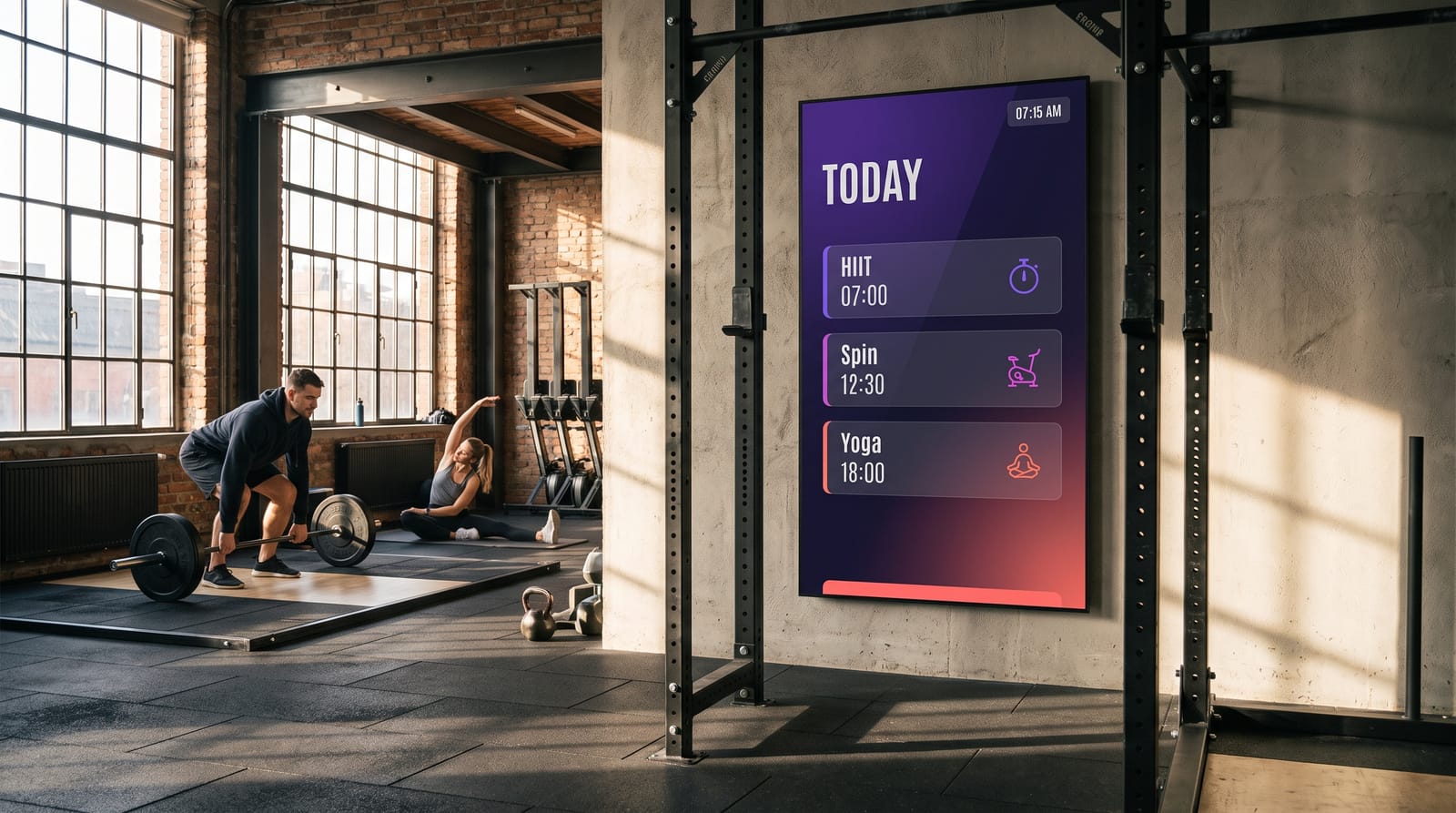
Where to put screens, and what size
| Location | Suggested size | Orientation | Job it does |
|---|---|---|---|
| Reception / front desk | 43”–55” | Portrait | Timetable, joining offers, opening hours |
| Studio door | 24”–32” | Portrait | What is on now, what is next in this room |
| Free-weights area | 55”–65” | Landscape | Silent video, technique, challenges |
| Cardio sightline | 43”–49” | Landscape | Timetable, clock, news ticker |
| Changing-room corridor | 32”–43” | Portrait | Notices, etiquette, offers |
| Studio interior | 55”–65” | Landscape | Class support content, cool-down |
| Pool or wet-area viewing | 43”–55” in an enclosure | Landscape | Lane timetable, safety notices |
| Café or crèche | 32”–43” | Landscape | Opening times, family classes, menus |
Two rules of thumb. Keep the smallest text at roughly 1/25 of the screen height, about 27 mm on a 55” panel, so it reads from three to five metres. And mount higher than you would in an office: people on the floor are standing, moving and often looking up from a machine, so the centre of a floor screen sits at 1.8 m to 2.0 m rather than 1.6 m, tilted down. Studio-door screens are the exception, read close up by someone standing still, so 1.5 m is right.
Heat, humidity and glare
Gyms are harder on screens than offices are, and the failure modes are predictable.
- Heat. A spin studio at 19:00 is a hot room with poor airflow. Leave the ventilation gaps the manufacturer specifies, never recess a screen into a tight box, and do not bury the player in an unventilated cavity behind it. Heat kills panels early more often than anything else does.
- Humidity and wet areas. Pool halls, steam rooms and the corridor outside them are chlorinated and humid, and a standard commercial panel is not built for that. Use a rated enclosure, or place the screen outside the wet zone behind glass.
- Glare. Gyms are full of glazing, rooflights and mirrors, and a mirror will bounce a window straight into your screen. Walk the room at the brightest hour before choosing a position. A commercial panel runs at roughly 350 to 700 nits against 250 to 350 on a domestic TV, and near glass you want the brighter end. A consumer TV is also rated for only a few hours a day, its warranty generally excludes commercial use, and it usually refuses portrait mounting. See LCD displays for digital signage.
- Players. easyCMS runs on Windows, Android, LG webOS and Samsung Tizen. An LG or Samsung commercial screen with the player built in needs no separate box, one less thing in a hot room. The player buying guide helps you choose.
What it costs: two worked examples
A single studio with three screens
Reception, one studio door, one screen on the floor.
| Line | Cost |
|---|---|
| easyCMS account, 1 licence included, up to 5 displays, 1GB storage | 49 EUR one-time |
| 2 × extra licence at 66 EUR, bought in the same order | 132 EUR one-time |
| Software total, paid once | 181 EUR |
Licences bought in the same checkout as the account are 66 EUR each instead of 99 EUR, a third off, applied automatically with no code to enter. Added later they are 99 EUR each, so the same three screens are 247 EUR at list.
Here is the honest comparison, using vendors’ own list prices checked September 2026, in the currency each vendor publishes.
| Three screens | Year 1 | Five years | easyCMS breaks even after |
|---|---|---|---|
| easyCMS, one-time | 181 EUR | 181 EUR | n/a |
| Yodeck Basic, EUR 8 per screen per month | 288 EUR | 1,440 EUR | about 8 months |
| OptiSigns Standard, EUR 7.50 per screen per month billed annually | 270 EUR | 1,350 EUR | about 8 months |
| OptiSigns Free, up to 3 screens | 0 EUR | 0 EUR | never |
The easyCMS line goes flat the day you buy it. Three screens cost 181€ once, about 60€ per screen, and the purchase has paid for itself against either subscription inside the first year. By year five those same three screens have still cost 181€, against 1,440€ on Yodeck Basic and 1,350€ on OptiSigns Standard, so you are roughly 1,259€ and 1,169€ ahead. Buy the screens later at 99€ a licence and the total is 247€, and the break-even moves out to about ten to eleven months.
The last row of that table is not a typo. OptiSigns has a genuine free tier covering exactly three screens, with the OptiSigns logo on your screens and community support only, and Yodeck’s free tier covers one screen forever. If you have three screens, no budget and no objection to someone else’s logo on your reception wall, those are real options and we will not pretend otherwise. What 181€ buys is a clean screen and no renewal conversation.
A ten-site chain with 25 screens
Reception at every club, plus studio-door and floor screens across the estate.
| Line | Cost |
|---|---|
| easyCMS PRO account, up to 25 displays, 5GB storage, proof of play, 1 licence included | 299 EUR one-time |
| 24 × extra licence at 66 EUR, bought in the same order | 1,584 EUR one-time |
| Software total, paid once | 1,883 EUR |
| Cumulative cost, 25 screens | easyCMS PRO | Yodeck Basic at EUR 8 | OptiSigns Standard at EUR 7.50 |
|---|---|---|---|
| Year 1 | 1,883 EUR | 2,400 EUR | 2,250 EUR |
| Year 2 | 1,883 EUR | 4,800 EUR | 4,500 EUR |
| Year 3 | 1,883 EUR | 7,200 EUR | 6,750 EUR |
| Year 4 | 1,883 EUR | 9,600 EUR | 9,000 EUR |
| Year 5 | 1,883 EUR | 12,000 EUR | 11,250 EUR |
| Break-even | n/a | about 9 months | about 10 months |
Buy the estate in one order and the whole thing is 1,883€, about 75€ per screen, paid once. It has covered itself in the first year against either subscription. By year three the same 25 screens have cost 1,883€ against 7,200€ on Yodeck Basic and 6,750€ on OptiSigns Standard, and by year five 12,000€ and 11,250€, so you are roughly 10,117€ and 9,367€ ahead. Nothing renews and nothing reprices.
Add the screens later instead and each licence is 99€, which puts the same 25-screen estate at 2,675€. At that price easyCMS does cost more than either subscription in year one, and only moves ahead after about 13 months against Yodeck and about 14 against OptiSigns. The method is in our cost per screen guide, and the wider argument on digital signage with no monthly fee.
Above 25 displays, or if you want each club on your own branded domain with separate logins and roles, the Enterprise account is 1,290€ per year, our only recurring plan. On Enterprise the licence price depends on what the screens run. Android, LG webOS and Samsung Tizen displays are 49€ each, because those players carry a commercial licence we buy in. Windows and Linux displays carry no licence charge at all, because that player software is free. Gym estates are usually Android boxes or webOS and Tizen panels with the player built in, which is the platform assumed here, so budget 49€ a screen: on Windows or Linux players that line disappears and the Windows route works out cheaper. On Android the annual fee pays for itself on licence savings alone at 26 displays. Enterprise also drops Android players to 299€, and it is what makes white label possible. Everything is on the pricing page. An easyCMS Android player is 499€ with one display licence included, so it replaces a licence line rather than adding to one.
Why capex suits an owner-operated gym
An independent owner already runs a long monthly direct debit list: rent, music licensing, insurance, card processing, cleaning, equipment finance. A per-screen subscription joins that list, grows every time someone hangs another screen, and has to survive every budget review for as long as the screens exist. A one-time licence is a purchase: you pay 181€ or 1,883€, you get a VAT invoice, and the line never comes back.
Good to know There is no free plan and no free trial of easyCMS. Every account except Enterprise is a one-time purchase, and the guides and the assistant are free to everyone.
What easyCMS will not do for a gym
Worth reading before you buy, because these are what people ask for once the screens are up.
- It does not connect to your gym management or class-booking platform. There is no integration marketplace and no ready-made connector. If your booking system publishes an iCal feed the calendar widget reads it; if not, you export a CSV into a DataSet or keep the timetable by hand. Check what your system exports before planning around automation.
- There is no live occupancy display. “Six spaces left in the 18:00” is not a built-in feature. It only works if your booking system publishes that number somewhere the CMS can read, as a webpage the CMS can display, or as a CSV you refresh into a DataSet. See webpages and embedded content.
- There is no charts widget, so no occupancy graphs or member-growth charts, and synchronised video walls are Android only.
- Proof-of-play reporting is PRO and Enterprise only, and user roles and permissions are Enterprise only. A chain wanting club managers scoped to their own screens needs Enterprise.
- You are not an administrator of the CMS. We host it in the EU and look after the platform settings, which is deliberate, but configuration changes come through us rather than a settings page you can reach.
- Support is human and it has hours. The free route is the assistant and the guides. Paid work is an Expert Support Hour at 25€, started the same working day when it is urgent. If you need someone faster, an expert support hour is 25€, includes a written diagnosis and a fixed quote before further work, is started the same working day when urgent, and is refunded if the cause turns out to be a bug in easyCMS.
Running it day to day
Who updates it. In a single site it is usually the club manager, about ten minutes a week once the layouts exist. In a chain, head office owns brand and offers while each club owns its timetable and notices. Timetables change seasonally, offers monthly, safety notices on demand, so build layouts where the frequent edits are text or data only.
Check screens without walking the floor. Display monitoring shows last check-in and connectivity for every screen, and you can pull an on-demand screenshot of what a display is playing right now. Across ten sites that is the difference between knowing and guessing. See display monitoring.
Group by role, not by building. All studio doors, all reception screens, all floor screens. A change to “all reception screens” reaches every club in one action while the timetable stays local. To start, connect your first display and build from a template in creating layouts.
Watch out Do not schedule one loop that runs all day. It is the most common mistake in fitness signage and it is why members stop looking after a fortnight. Dayparting is already in the product, and it is the whole reason a screen beats a poster.
Questions gyms ask
Can the timetable update itself from our booking system?
Only if that system publishes an iCal feed, which the calendar widget reads directly. Otherwise the timetable lives in a DataSet you refresh from a CSV or edit in the browser. There is no direct integration with booking platforms.
What happens if the club’s Wi-Fi drops?
Nothing visible. Content is cached on the player, so the scheduled timetable and video keep playing. The player picks up your changes when the connection returns.
Can I show a different timetable at each club?
Yes. Group displays per club, schedule the timetable per group, and push chain-wide offers to every screen at once. One account manages the whole estate.
Do the studio-door screens need a licence too?
Yes, one per screen whatever its size. A 24” studio-door display needs the same licence as a 65” wall: 66€ if it goes through checkout with your account, 99€ if you add it later. There is no monthly fee on any of them. Enterprise, at 1,290€ per year, is our only recurring plan.
Working out what you need
Sketch the building first: reception, studio doors, the floor, the corridor. Name the job each screen does and count them. That number decides whether you want the 49€ account, the 299€ PRO account or Enterprise, and it is the only figure we need to quote hardware.
Send us the list and we will say honestly whether easyCMS fits it, including the cases where a free tier elsewhere would serve you better. Email info@myeasycms.com, call +48 509 937 137, or use the support request form. The features page lists what is available, and the equivalent guides for offices and restaurants and bars may also help.