
easyCMS has no recurring fee on the one-time plans. Once you purchase the player or licence there are no other software costs. This is a perfect solution for schools, colleges, and universities that want to save on deployment. Our all in one package contains an LCD display, an Android player and a wall mount. These are specially selected to offer lasting performance at the best price. Plus we offer a 30% discount to all schools and student organisations.
Schools have a particular reason to care about how signage is priced. A per-screen monthly subscription is an operating cost that has to be defended in every budget round, and it grows every time someone adds a screen. A one-time licence is a capital purchase that stays bought. This page covers what to put on the screens, where to put them, and what a twelve-screen secondary school actually pays over five years.
The advantages
- Affordable digital signage solution
- Discount of -30% for schools
- Inform students and teachers easily
- Communicate in a dynamic and modern way
- Easily broadcast information and alerts
- Manage one or more screens from a central point
What actually goes on the screens
Using Digital Signage in schools has many advantages. First it will add a modern and interactive way to inform students about what’s happening. Then it has the possibility to be updated instantly in case of special events, or even emergencies. Here is the content that earns its place.
Timetables, room changes and cover
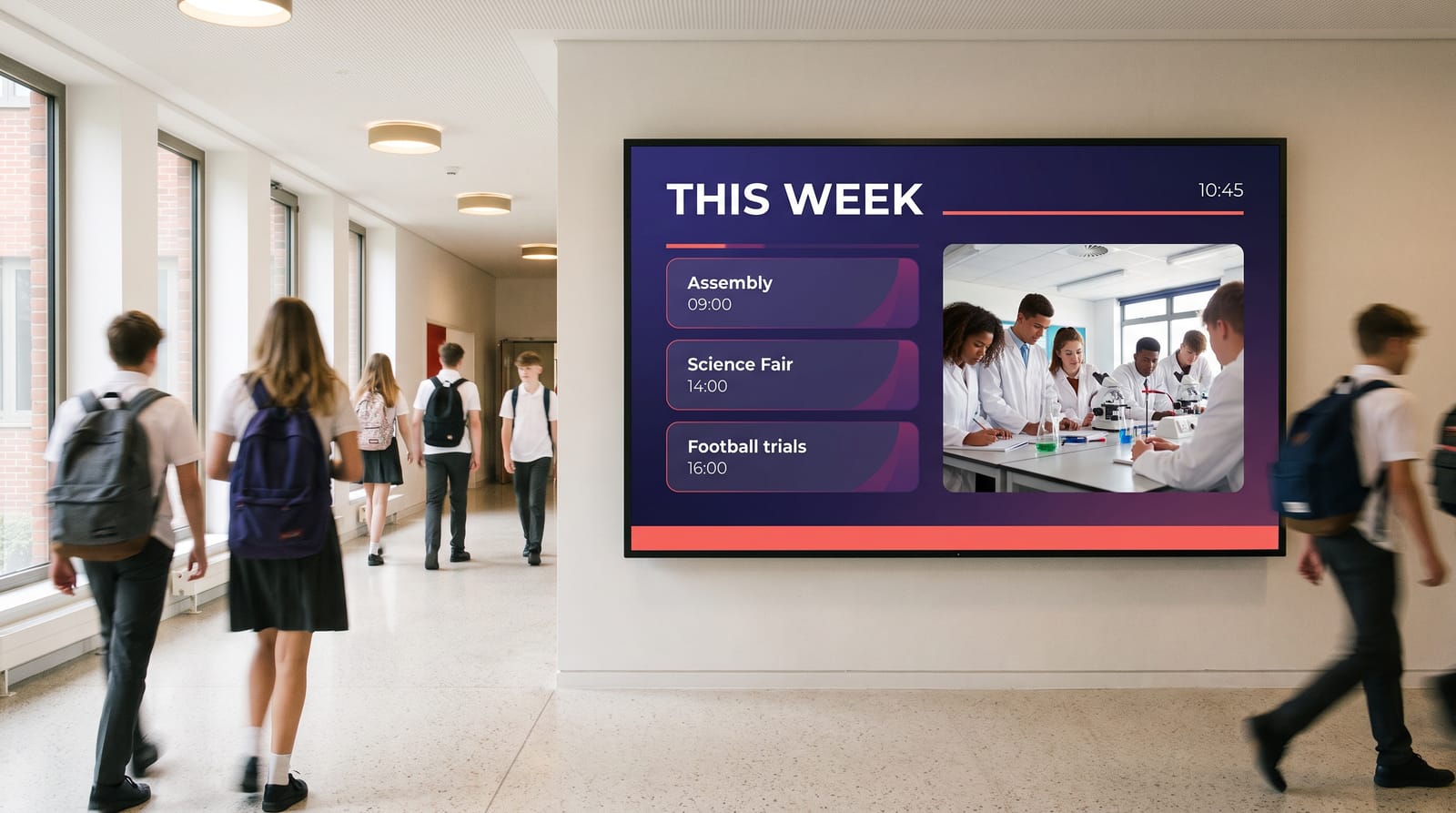
The workhorse. A screen in a corridor showing today’s period-by-period room changes and staff absences replaces a crowd around a printed sheet outside the staff room. Push a change at 08:20 and it is on every screen in the building before registration.
Exam information
Exam timetables, room allocations, seat numbers, what candidates may bring in, and the walking route to the sports hall. In exam season this content alone justifies the screens, and it changes often enough that print cannot keep up.
Emergency, weather and closure notices
A snow closure, a burst pipe, a lockdown drill, a fire assembly reminder, an early finish. Screens can be overridden instantly with a full-screen notice that takes priority over everything scheduled, and reverted just as quickly. This works alongside your text and email systems, not instead of them, but it reaches everyone already in the building, including visitors.
Celebrating student work
Artwork, photography, coursework, sports results, music performances, competition winners, the school production. This is the content students stop to look at, and it is the reason the timetable panel next to it gets read. A rotating gallery of Year 10 photography does more for the atmosphere of a corridor than any amount of laminated A3.
Canteen menus and queues
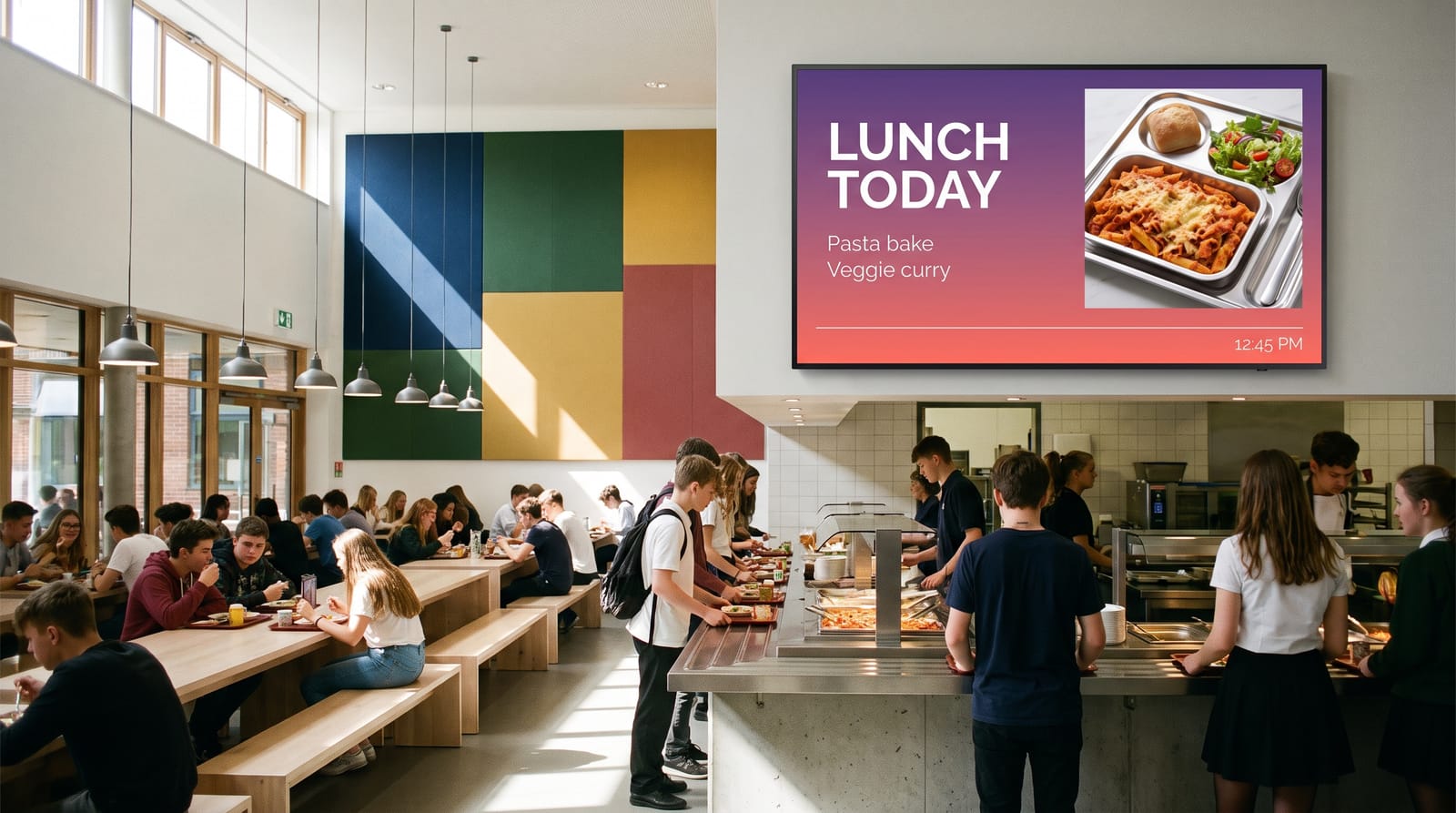
Today’s menu with prices and allergen markers, what has sold out, and which queue is shorter. Menus on screen also cut printing and let the catering team change a dish at 11:30 without reprinting anything.
Visitor welcome and safeguarding
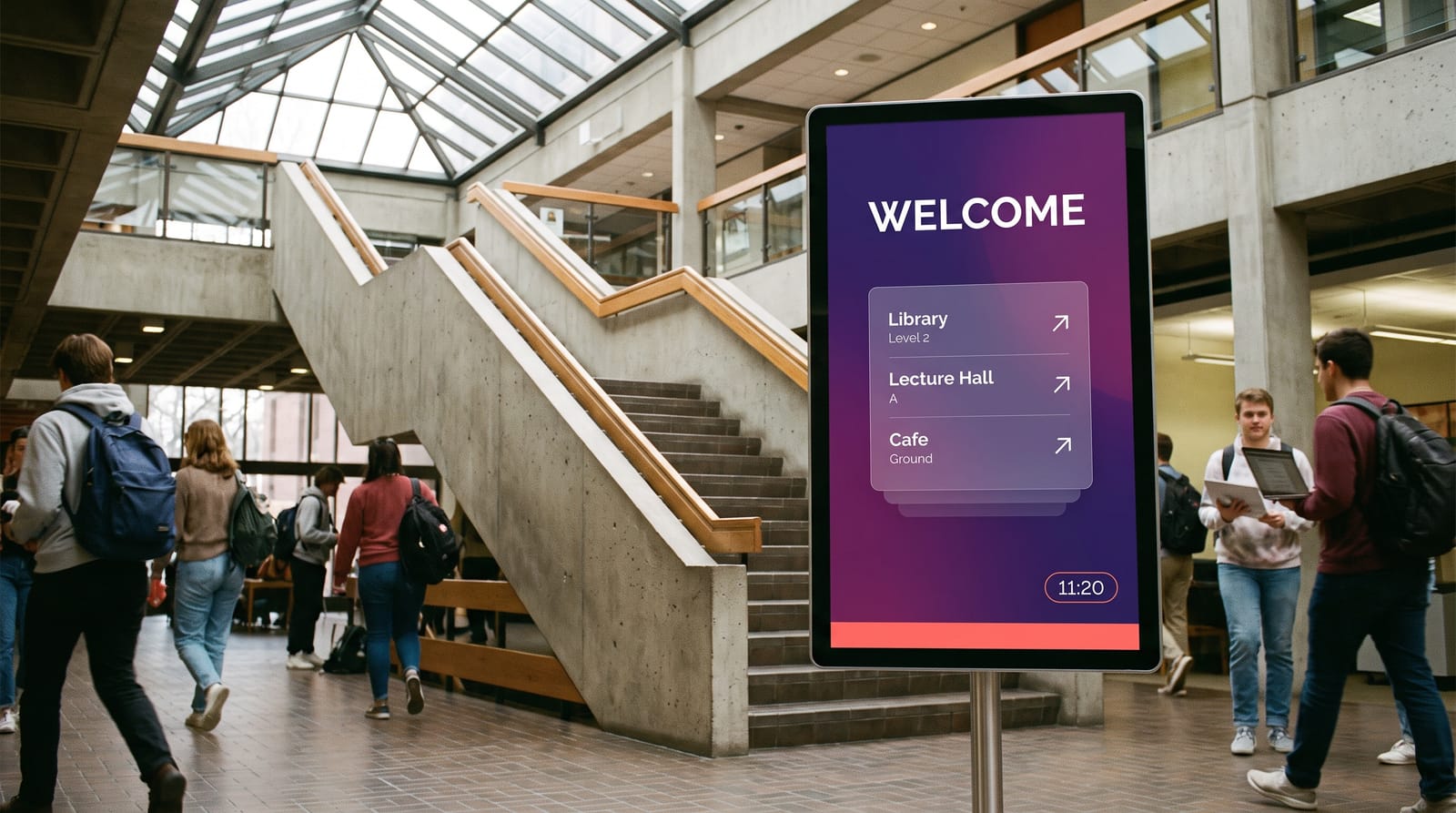
A reception screen that names the visiting governors or the exam board inspector, alongside sign-in instructions, safeguarding contacts and the visitor lanyard policy. Reception screens do real work in schools because almost every visitor is a first-time visitor.
Staff room boards
Briefing notes, INSET details, duty rotas, CPD opportunities, deadlines for reports, union notices. Staff-facing content should live on staff-facing screens so it does not dilute the student-facing loops.
Wayfinding and events
Open evening routes, parents’ evening room lists, sixth-form taster days, sports fixtures, bus times, club sign-ups. Events are where digital signage saves the most administrative time, because a change to a room list becomes one edit rather than forty printed signs.
Where to put screens, and what size
| Location | Suggested size | Orientation | Job it does |
|---|---|---|---|
| Main entrance / reception | 55”–65” | Portrait | Welcome, visitor info, school brand |
| Main corridor junctions | 49”–55” | Portrait | Timetable changes, notices, news |
| Canteen | 55”–65” | Landscape | Menus, prices, allergens |
| Sports hall / gym | 65”–75” high brightness | Landscape | Fixtures, results, exam layout |
| Staff room | 43”–49” | Landscape | Briefings, rotas, CPD |
| Library / sixth-form area | 43”–49” | Portrait | Deadlines, university dates, study info |
| Department corridors | 43”–49” | Portrait | Subject news, student work |
Mounting height matters more in schools than anywhere else. Put the centre of the screen at about 1.6 m in a staff area, but higher in a corridor where a hundred students walk past at once and the bottom of the screen would otherwise be blocked by heads. A screen students can reach is a screen that gets touched, so in high-traffic corridors mount above reach and tilt down slightly.
Corridors are usually portrait: they match the wall shape and read as a single scrolling column. Canteens and halls are usually landscape, where you have distance and want video.
What it costs: a worked example
Take a secondary school of about 900 students. Twelve screens: main entrance, three corridor junctions, canteen, sports hall, staff room, library, sixth-form area and three department corridors.
Because that is more than five displays, the PRO account is the right tier:
| Line | Cost |
|---|---|
| easyCMS PRO account, up to 25 displays, 5GB storage, proof of play, includes 1 licence | €299 one-time |
| 11 × extra licence at €66, bought in the same order | €726 one-time |
| Software total, paid once | €1,025 |
Good to know Licences bought in the same order as an account are €66 each instead of €99, a third off. The discount is applied automatically at checkout, there is no code to enter. Licences added later are €99 each, so the same twelve screens bought a few at a time over a couple of years come to €1,388 rather than €1,025. Both figures are one-time.
Then the line goes flat. There is no renewal, no per-screen fee and no annual increase, so year two costs nothing, and so does year five. Compare that with a per-screen subscription, which is how most signage platforms are sold. Rates typically fall between €15 and €25 per screen per month; €20 is used below.
| easyCMS | Subscription at €20/screen/month | |
|---|---|---|
| Year 1 | €1,025 | €2,880 |
| Year 2 | €0 | €2,880 |
| Year 3 | €0 | €2,880 |
| Year 4 | €0 | €2,880 |
| Year 5 | €0 | €2,880 |
| Five-year total | €1,025 | €14,400 |
The whole purchase is covered by what a €20 subscription would bill for twelve screens in a little over four months: €240 a month against €1,025 once. By the end of year three the subscription has taken €8,640 and easyCMS has taken €1,025. By the end of year five the difference is €13,375 across twelve screens, about €17 per screen per year with easyCMS against €240 per screen per year on subscription. If you buy the screens a few at a time instead and pay €99 a licence, the five-year total is €1,388, about €23 per screen per year, and it still pays for itself before month six. The gap widens every year, and it widens again for a multi-academy trust running the same setup across several sites. Our cost per screen guide shows the working.
A smaller primary school with four screens does not need PRO at all: the easyCMS account at €49 includes a licence and covers up to five displays, so four screens is €49 plus three licences at €66 in the same order, €247, paid once. Added later those three licences are €99 each, so the same four screens come to €346.
A trust running more than 25 displays, or one that wants separate logins per school with its own branding and domain, wants the Enterprise account at €1,290 a year, which also brings players down from €499 to €299. On Enterprise the licence price depends on the platform. Android, LG webOS and Samsung Tizen displays are €49 each, because those players carry a commercial player licence we buy in. Windows and Linux displays carry no licence charge at all, because that player software is free. Most school estates already have Windows machines, so the Windows route is the cheaper one: those screens add nothing per display. On Android, the annual fee pays for itself on licence savings alone at 26 displays, since each licence saves €50 against the €99 list price and €1,290 divided by €50 is 25.8. Full detail on the pricing page.
Hardware sits alongside this. An easyCMS Android player is €499, arrives pre-configured and includes one display licence, so budget a licence line for every player you order: the player replaces the box behind the screen, not the licence. Our 30% schools discount applies to the LCD and player bundle, so ask for a quote rather than working from list price. You can also run easyCMS on Windows machines you already have, or on LG commercial screens with webOS built in and no separate box at all. The guides and the assistant are free to everyone, and an expert hour is €25 if you need someone hands-on.
Running it day to day
Who updates it. The realistic answer in most schools is the office team for daily notices, a member of the IT or network team for the technical side, and one enthusiastic teacher or the marketing lead for the student-work content. Daily updates take a few minutes; the design work happens once a term.
Involve students. Sixth-formers or a media club can run the student-facing loop. Give them a locked-down layout where they can swap images and text but cannot touch the timetable panel or the emergency template, and it becomes a genuine enrichment activity rather than a job for an already busy adult.
How often. Timetable and cover changes daily, before registration. Menus daily or weekly. Student work weekly or fortnightly. Exam content in bursts. Emergency notices on demand.
Scheduling for a school day. Schedule around the bell rather than running one loop all day: timetable and cover panels before 09:00, canteen menus from 11:30 to 14:00, clubs and after-school content from 15:00, an open-evening loop on the evenings it is needed, and screens that switch themselves off in the holidays. See scheduling content.
Who needs access. Keep publishing rights tight. The office and senior leadership should be able to publish anywhere including the emergency override; departments should be scoped to their own corridor group; students should be scoped to the student-work group only. This is exactly what display groups and user permissions are for.
Several sites. If you manage several schools or campuses in different locations you can update and change the content in one place. You can tailor the content to each location as well, a trust-wide announcement goes to every screen at once while each school keeps its own notices, menus and student work.
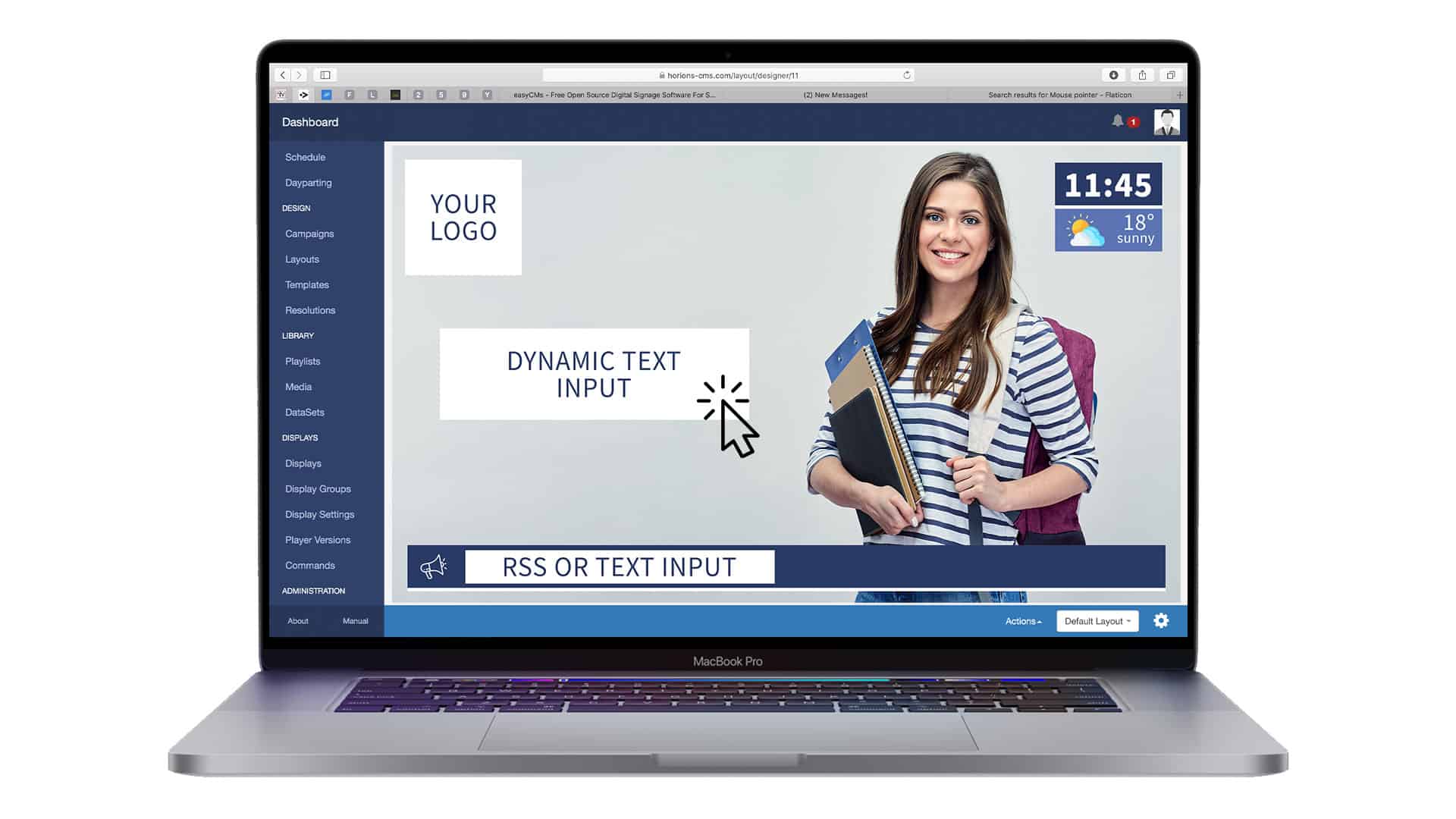
Getting going. Connect your first display, then build from a template in creating layouts.
Custom Layout
Content is king! Indeed the acquisition of an LCD screen and a Digital Signage solution is only the beginning. Fuelling your screen with quality content on a suitable digital layout is the key to success. Our experience in creating content for digital signage is put to your benefit. You can use pre-configured layouts or we can create one as needed. If you wish, you can even create the layout yourself. The features page covers what is available.
Hardware notes for school buildings
School corridors are harder on equipment than offices are. A few things worth deciding before you order.
- Mount out of reach. In a busy corridor, put the bottom of the screen above roughly 2 m. It stops casual contact, keeps the view clear over a crowd, and removes most of the vandalism risk in one decision.
- Consider an enclosure. In sports halls, dining halls and areas near ball games, a protective enclosure or an anti-ligature mount is cheaper than replacing a panel. Ask about it for any screen below 2.5 m in a high-energy space.
- Secure the mount, not just the screen. Use a locking wall mount with security fixings, and cable the player to the bracket behind the screen so there is nothing loose to remove.
- Commercial panels, not TVs. School screens run all day, five days a week. A commercial panel is rated for 16/7 or 24/7 use and runs at 350 to 700 nits; a consumer TV runs at 250 to 350 and its warranty generally excludes commercial installation. Corridors with glazing need the brighter end. Commercial panels also support portrait mounting, which most consumer sets do not.
- Power and network. Get a socket behind the screen at first fix if you can, and run Ethernet to it. Where you cannot, Wi-Fi is fine: content is cached on the player, so a school network outage or a blocked internet connection does not blank the screens. Scheduled content keeps playing. More on that in digital signage without internet.
- Network policy. Talk to your IT team early about which outbound connections the player needs. It is a five-minute conversation before installation and a frustrating one afterwards.
- Players. easyCMS runs on Windows, Android and LG webOS. Schools with existing Windows machines can often use them. The player buying guide helps you decide.
A complete solution
Our all in one solution reflects our philosophy of simplifying Digital Signage. When you buy our solution with LCD screen, everything is included. Your player is pre-configured with your content and adapted layout. The screen is delivered with its standard wall mounting. Installation is very simple, It’s Just Plug & Play!
Questions schools ask
How does the 30% school discount work?
It applies to our LCD display and Android player bundle for schools, colleges, universities and student organisations. Tell us what you need when you ask for a quote and we will apply it.
Can we push an emergency notice to every screen at once?
Yes. Build a full-screen closure or emergency layout in advance, keep it ready, and publish it to all display groups in one action. Reverting is one action too. Because content is cached locally, screens already showing the notice keep showing it even if the network then fails.
Will it work on our locked-down school network?
In most cases yes, with the right outbound access agreed with your IT team. The player caches content, so it does not need a permanent connection to keep displaying, it needs a connection to receive updates.
Can students help run it?
Yes, and it works well. Scope a student group to a single display group and a single layout so they can publish their own content without being able to touch timetables, staff notices or the emergency template.
Do we pay per screen every year?
No. Licences are one-time and lifetime. The PRO account is a one-time €299. The only annual option is the Enterprise account, for trusts above 25 displays.
Can we use screens we already own?
Usually. Any screen with an HDMI input will work with a player. If it is a domestic TV it will do the job, but expect a shorter life and a dimmer picture than a commercial panel. See LCD displays for digital signage.
Get a quote for your school
Send us a rough list, how many screens, roughly where, and whether you need hardware, and we will come back with a firm figure including the school discount. We are a European company (DynamicDigital sp. z o.o., Warsaw, Poland, VAT PL5213678094) and provide a VAT invoice for your finance office.
Email info@myeasycms.com, call +48 509 937 137, or use the support request form. You can also read what digital signage is, see what others have built, read about the free digital signage software easyCMS runs on, or look at the equivalent guides for offices and internal communication and restaurants and bars.